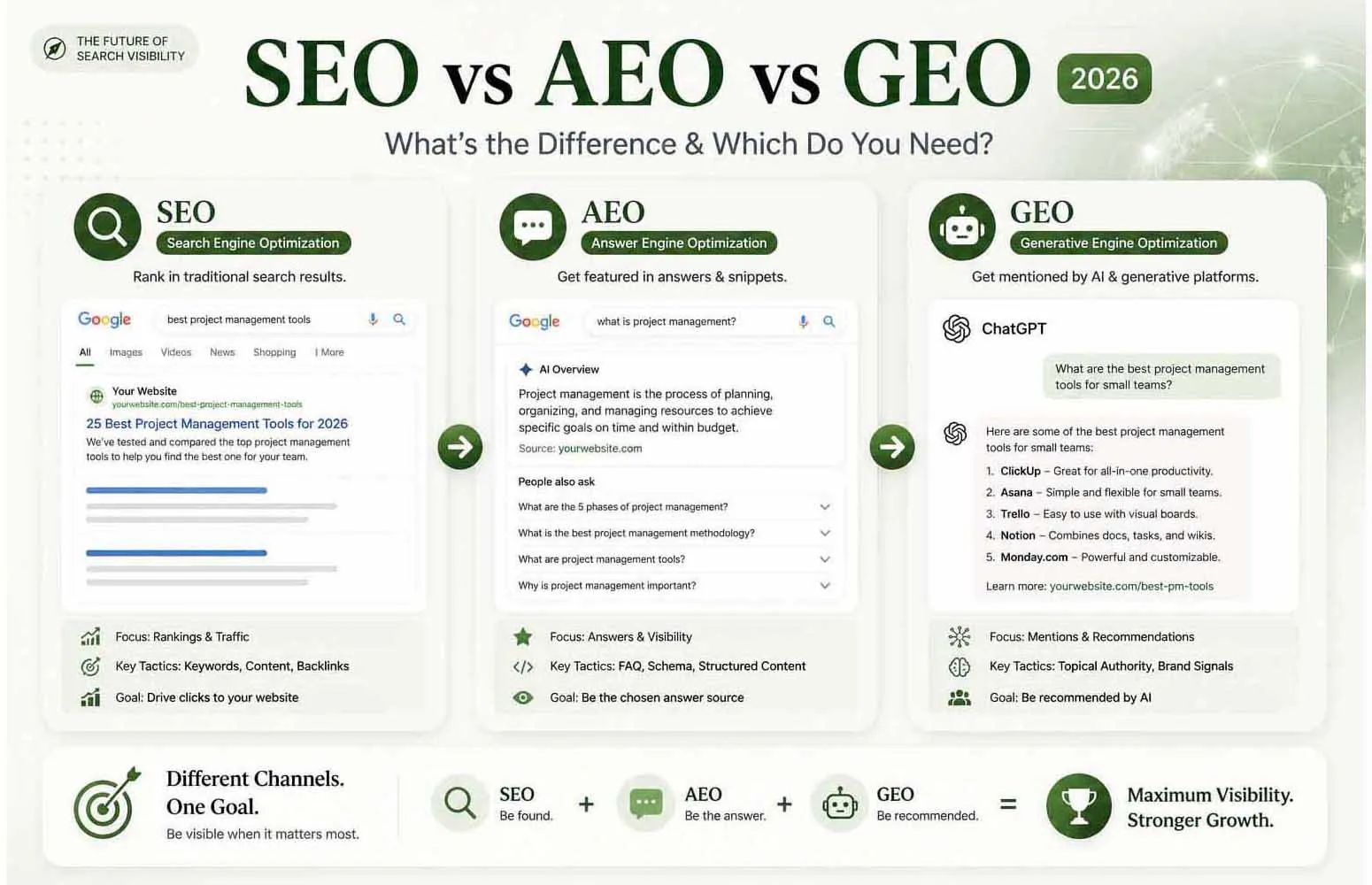
What is the Search Stack in 2026?
Search has changed more in the last two years than in the previous decade. When someone wants to find a product, answer a question, or discover a service, they no longer rely only on Google's ten blue links. They ask ChatGPT. They use Perplexity. They speak to Siri or Alexa. Google's own AI Overviews now answers questions before the user even sees a website.
For businesses and content creators, this means your digital visibility strategy must go beyond traditional SEO. It must account for three distinct layers: Search Engine Optimization (SEO), Answer Engine Optimization (AEO), and Generative Engine Optimization (GEO).
Quick takeaway: SEO gets you ranked on Google. AEO gets you into AI-powered answer boxes. GEO gets you cited by ChatGPT, Gemini, and Perplexity. You likely need all three.
What is SEO (Search Engine Optimization)?
SEO is the practice of optimizing your website so it ranks higher on search engines like Google and Bing for relevant keywords. It's been the backbone of digital marketing for over 25 years and remains essential — but it's no longer sufficient on its own.
Core SEO components
- On-Page SEO — Optimizing titles, meta descriptions, headings, content quality and keyword placement
- Technical SEO — Site speed, Core Web Vitals, crawlability, indexation, and structured data
- Off-Page SEO — Link building, digital PR, brand mentions and authority signals
- Local SEO — Google Business Profile, citations, and Map Pack rankings
What is AEO (Answer Engine Optimization)?
AEO is the process of structuring your content so it appears in direct answer formats — featured snippets, People Also Ask (PAA) boxes, voice search results, and Google's AI Overviews. Instead of ranking for a keyword, you're answering a specific question better than anyone else.
What AEO targets
- Featured Snippets — The paragraph, list, or table Google shows at position zero
- People Also Ask (PAA) — The expanding question boxes that appear mid-results
- Voice Search — Smart speaker and mobile voice assistant answers
- AI Overviews — Google's generative AI summaries shown above organic results
"If SEO is about ranking, AEO is about answering — and the brands that answer best get the attention before the user even scrolls."
What is GEO (Generative Engine Optimization)?
GEO is the newest layer. It refers to optimizing your brand's presence so that large language models (LLMs) like ChatGPT, Google Gemini, and Perplexity cite or recommend your brand when users ask relevant questions.
Unlike SEO and AEO which operate within search engines, GEO operates within AI models that have been trained on massive datasets. These models don't crawl your website in real time — they reflect the information they were trained on and the sources they can access.
GEO strategies include
- Building brand entity presence (Wikipedia, Wikidata, structured knowledge)
- Getting cited in high-authority publications that LLMs are trained on
- Creating authoritative content that answers the exact questions users ask AI tools
- Monitoring your brand's presence in ChatGPT, Gemini and Perplexity responses
Side-by-Side Comparison
| Dimension | SEO | AEO | GEO |
|---|---|---|---|
| Target Channel | Google/Bing rankings | Answer boxes, voice | ChatGPT, Gemini, Perplexity |
| Goal | Page 1 rankings | Zero-click answers | LLM citations |
| Key Tactic | Keywords + links | FAQ + structured data | Entity building + authority |
| Speed of Results | 3–6 months | 4–8 weeks | Ongoing |
| Maturity | 25+ years | 5–7 years | Emerging (2023+) |
Where SEO, AEO and GEO Overlap
The three labels describe different outcomes, but most of the work behind them is shared. A page that search engines can crawl, that answers a question clearly and that comes from a recognisable, trustworthy source serves all three at once. That is why you don't need three separate content programmes.
| One piece of work | SEO benefit | AEO benefit | GEO benefit |
|---|---|---|---|
| A question heading with a short, direct answer beneath it | Matches search intent | Easy to extract as a snippet or PAA answer | A passage an AI system can quote |
| A clear author, about page and consistent brand name | Stronger trust signals | A credible source for answers | A clearer entity for the brand |
| Original examples, data or case studies | Earns links and shares | A unique answer worth showing | A reason to be cited rather than paraphrased |
| Clean technical foundations: indexable, fast, structured | Crawlability and indexing | Eligibility for snippets and rich results | Pages assistants can retrieve and read |
Common Myths About the Three
- "AEO and GEO replace SEO." They build on it. AI features in search draw on pages that are already indexed, and assistants with live web access generally rely on pages they can reach. Weak SEO makes the other two harder.
- "You need a special file or markup to appear in AI answers." No file or schema type is a confirmed requirement. Structured data and files such as llms.txt may help systems understand your site, but none guarantees inclusion (see llms.txt explained).
- "GEO can guarantee citations." It can't. AI answers vary by user, location, wording and model version, so anyone promising a fixed result is overselling.
- "SEO is dead." Search engines still send visitors, and the pages they rank are often the ones AI systems read. Measure all three instead of abandoning the one with the longest track record.
How to Measure Each Layer
| Layer | What to watch | Where |
|---|---|---|
| SEO | Impressions, clicks, average position, organic sessions and conversions | Search Console, GA4, a rank tracker |
| AEO | Snippet and PAA presence, plus impressions and CTR on question-style queries | Search Console with a query filter, a rank tracker that reports SERP features |
| GEO | Whether and how assistants mention your brand, plus referral visits from AI tools | A monthly prompt test and GA4 referral reports (see tracking AI referral traffic in GA4) |
One caution: AI answers change between sessions. Treat a single result as one data point and track the trend over several tests, not one lucky or unlucky screenshot.
Which One Do You Need?
Start with SEO
If you don't have SEO in place, start here. It's the foundation. Without solid on-page, technical and off-page SEO, the other layers are harder to build.
Layer in AEO
Once you rank for target keywords, restructure content to capture featured snippets and PAA boxes. Add FAQ schema. This is where existing traffic gets multiplied.
Build for GEO
As your brand authority grows, focus on being cited by AI systems. Build your entity, get coverage in authoritative publications, and create content that AI models reference.
Most established businesses need all three. But if you're starting from zero, prioritise SEO → AEO → GEO in that sequence.
How the Priorities Shift by Business Type
| Business | Lead with | Then add |
|---|---|---|
| Local service business | Local SEO and a complete Google Business Profile | AEO for common customer questions; consistent listings for GEO |
| Online store | Technical SEO, category and product pages | AEO for buying-guide questions; reviews and third-party mentions for GEO |
| Consultant or agency | Service pages and case studies that rank for specific searches | AEO through clear explainers; GEO through expert mentions and a consistent profile |
| Publisher or blog | Topical depth and internal linking | AEO formats for question queries; GEO through citations from other sites |
A 90-Day Starting Plan
- Days 1–30, foundation (SEO): fix crawling, indexing and speed problems using the technical SEO checklist, and map each important page to one clear target topic.
- Days 31–60, answers (AEO): pick your ten most important pages and add question headings with short direct answers, following the People Also Ask guide and the AI Overviews guide.
- Days 61–90, presence (GEO): tidy your brand profiles, earn a few relevant mentions and start a monthly prompt test, as described in What Is GEO.
Review the results at day 90, keep what moved the numbers and drop what didn't.
Conclusion
SEO, AEO and GEO are not competing strategies — they're complementary layers of a complete search visibility system. Each one targets a different moment in the user's journey: the scroll, the quick answer, and the AI conversation.
The businesses that will dominate search in 2026 and beyond are those that build visibility across all three channels. If you're only doing SEO, you're leaving significant traffic on the table.
Frequently Asked Questions
SEO (Search Engine Optimization) is the practice of optimizing your website to rank higher on search engines like Google for relevant keywords.
AEO (Answer Engine Optimization) is the process of structuring content to appear in direct answer formats — featured snippets, People Also Ask boxes, voice search, and Google AI Overviews.
GEO (Generative Engine Optimization) is optimizing your brand so that large language models like ChatGPT, Gemini, and Perplexity cite your brand when users ask relevant questions.
Start with SEO as the foundation, then layer in AEO to capture featured snippets, then build for GEO as your authority grows. Most established businesses benefit from all three simultaneously.
SEO targets Google rankings. GEO targets AI-generated responses in tools like ChatGPT and Perplexity. They require different strategies — GEO focuses on entity building and authority citations rather than keywords.
AEO includes featured snippets but also covers People Also Ask boxes, voice answers and AI summaries. The shared habit is leading with a short, accurate answer under a clear question heading.
It's much harder. AI systems with live web access generally rely on pages that are already accessible and well regarded, so crawlability, quality content and authority still come first.
In GA4, look for referral sources from AI assistants and compare landing pages over time. Referral data is incomplete because some assistants don't pass a referrer, so treat it as a minimum, not a total.
Need Help with SEO, AEO or GEO?
Let's build a visibility strategy that works across Google, AI answers and generative search.
Start a Free Consultation