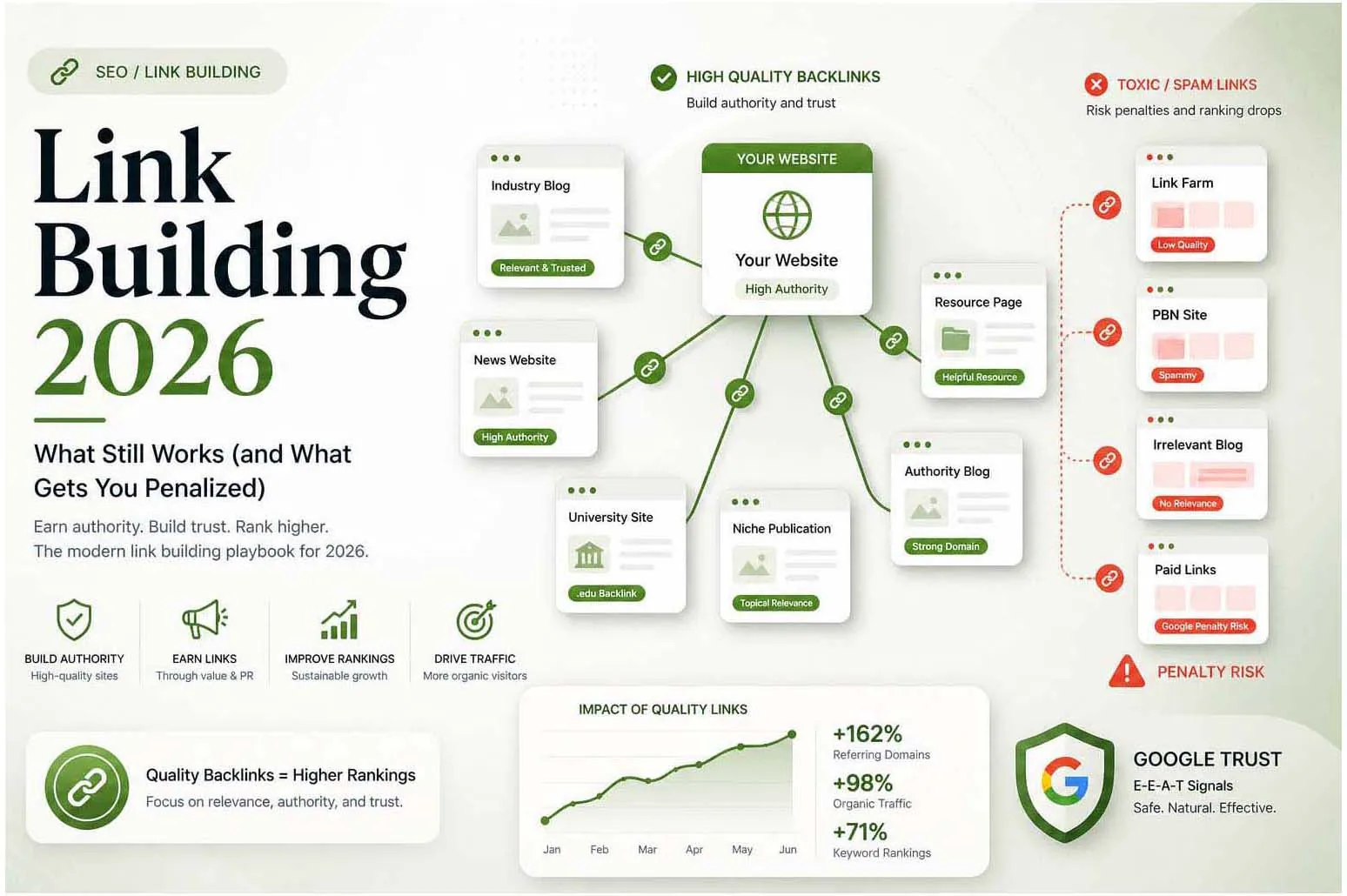
The State of Link Building in 2026
Google's Helpful Content Update, Link Spam Updates, and the March 2024 Core Update collectively devastated sites that relied on low-quality link building. Sites with hundreds of spammy backlinks saw catastrophic ranking drops. Meanwhile, sites with fewer but genuinely earned links maintained or improved their positions.
The message is clear: link building in 2026 is about earning authority, not manufacturing it. Here's what that looks like in practice.
Warning: Buying links, participating in link schemes, or using automated link-building tools now carries a high penalty risk. Google's AI-powered spam detection has made these tactics far easier to detect.
What Still Works in 2026
Digital PR & Earned Media
Getting mentioned in genuine news articles, industry publications, and authoritative blogs. This is the gold standard. A single link from a major publication like Forbes or a respected industry site is worth more than 1,000 directory links.
Original Research & Data
Publishing original studies, surveys, or data that other websites want to cite. When you produce data others reference, links come naturally. Create annual reports, surveys of your audience, or compile industry statistics.
Guest Posting on Relevant Sites
Writing genuine, high-quality articles for relevant websites in your niche. The key word is relevant — a guest post on a topically related site passes far more value than one on a generic blog network. Always prioritise editorial standards over volume.
Resource Page Link Building
Finding "best resources" or "useful links" pages in your niche and reaching out to suggest your content. This works when your content genuinely deserves to be there — not just as a link-grabbing exercise.
Broken Link Building
Finding broken links on authoritative sites and suggesting your content as a replacement. Tools like Ahrefs and Screaming Frog can identify broken outbound links at scale. A high success rate with low effort.
HARO / Expert Quotes
Responding to journalist requests on platforms like Help a Reporter Out (HARO), Qwoted, or SourceBottle. When journalists quote you, they link back to your site. Low cost, high authority.
Create Something Worth Linking To
Outreach works far better when you have something that deserves a link. The most reliable "linkable assets" share one trait: they give other writers something they can't easily get elsewhere.
- Original data you really have: results from your own work, a customer survey or a dataset you compiled, with the method explained
- Free tools and calculators that solve a small, specific problem
- Templates and checklists people can copy straight into their own work
- Case studies with real figures and a clear explanation of what was done
- Definitive explainers or glossaries that are accurate, current and easy to cite
Only publish numbers you can back up. A claim you can't source is a liability, and journalists and editors check.
Link Building for Local and Regional Businesses
If you serve a specific city or country, local relevance can beat raw authority. Look for links from organisations that genuinely know you:
- Trade bodies, chambers of commerce and industry associations you belong to
- Suppliers, partners and clients who can mention your work on their sites
- Local news outlets and community blogs, through genuinely newsworthy stories
- Universities and training institutions you collaborate with
- Sponsorships and events, where the link is a by-product of real involvement
- Curated industry directories that a real person reviews, not mass-submission lists
What to Avoid in 2026
| Tactic | Risk Level | Why |
|---|---|---|
| Buying links | 🔴 Very High | Direct violation of Google's guidelines — manual penalty risk |
| Private Blog Networks (PBNs) | 🔴 Very High | Google's AI detects footprints reliably now |
| Low-quality directory submissions | 🟡 Medium | Wasted crawl budget, no value, potential dilution |
| Comment link spam | 🟡 Medium | All nofollow, zero SEO value, looks spammy |
| Generic guest post networks | 🔴 High | Google identifies and discounts these at scale |
| Reciprocal link schemes | 🟡 Medium | Unnatural pattern, easy to detect algorithmically |
Link Attributes: nofollow, sponsored and ugc
Google asks site owners to label the kind of link they publish, and treats the labels as hints:
| Attribute | Use it for |
|---|---|
rel="sponsored" | Paid placements, advertorials and affiliate links |
rel="ugc" | Links inside comments, forums and other user-generated content |
rel="nofollow" | Links you don't want to vouch for, when neither of the above fits |
If you pay for a placement, label it. Buying links that pass ranking credit without a label breaks Google's guidelines, which is why the risk in the table above is rated so high.
Quality vs Quantity: The 2026 Formula
A study of 11 million Google search results found that the number one ranking result has an average of 3.8x more backlinks than results in positions 2–10. But those links are vastly different in quality. Here's how to think about it:
Outreach That Gets Responses
Most link outreach emails are ignored. The ones that work share three things: they are personalised, they offer genuine value, and they make the ask easy to fulfil. A framework that works:
- Research first — Read the target website, know their content, mention something specific
- Lead with value — Point out a broken link, suggest an improvement, offer a data point
- Keep it short — Under 150 words. Editors are busy
- One clear ask — Don't ask for multiple things in one email
- Follow up once — A single polite follow-up after 7 days is acceptable
A Simple Outreach Template and Follow-Up Schedule
Subject: A suggestion for your [page title] page
Hi [name],
I read your guide on [topic], especially the part about [specific detail]. One of the links in the [section] section, [broken or outdated URL], no longer works. I recently published [your resource], which covers the same ground and might be a useful replacement. Either way, thanks for a helpful article.
[Your name]
- Day 0: send the email to one named person, not a generic address when you can avoid it
- Day 7: send one short, polite follow-up
- After that: stop. Repeated chasing damages the relationship and your reputation.
Measuring Link Building Impact
- Track Domain Rating (Ahrefs) or Domain Authority (Moz) monthly — but treat these as proxies, not gospel
- Monitor ranking changes for target keywords after new link acquisition
- Track referring domains growth in Google Search Console
- Measure organic traffic trends 30–90 days after link campaigns
Auditing the Links You Already Have
Before building more, see what you've earned. In Search Console, the Links report shows your top linking sites and most-linked pages.
- Find your link magnets. Pages that already attract links show what your audience values; update and promote them.
- Reclaim mentions. Search for your brand name and find articles that mention you without linking, then politely ask for a link.
- Fix lost links. If a page with links was deleted or moved, redirect it to the closest relevant page.
- Be careful with disavow. Google describes the disavow tool as an advanced feature that most sites don't need. Use it only for manipulative links you or someone working for you built, not because a few strange sites link to you.
Choosing the Right Tactic for Your Situation
| Your situation | Best starting tactic | Why |
|---|---|---|
| New site with almost no links | Mentions from suppliers, clients, partners and associations | Real relationships are quick to build and clearly relevant |
| Local or regional business | Local organisations, news and curated directories | Local relevance matters more than global authority |
| Expert or consultant | Expert quotes and guest articles on relevant sites | Your knowledge is the asset editors want |
| Business with proprietary data or results | Original research and case studies | Unique information earns citations naturally |
| Large content library | Broken-link and resource-page outreach | You can offer replacements for existing dead links |
Conclusion
Link building in 2026 rewards patience and genuine value creation. The sites winning are those that produce content worth linking to, build real relationships with publishers, and focus relentlessly on relevance over volume.
If your current link profile is full of low-quality links, a disavow audit may be necessary before any new building begins. Build clean, build slow, build forever.
Frequently Asked Questions
Yes. Quality links remain a top Google ranking signal. A few authoritative relevant links outperform hundreds of low-quality ones.
Digital PR, original research, relevant guest posts, resource page building, broken link building, and HARO expert quotes.
Buying links, PBNs, generic guest post networks, comment spam, and reciprocal link schemes.
No magic number. Focus on relevance and authority, not volume.
Yes. Google asks that paid placements, affiliate links and sponsored content use rel="sponsored", and user-generated links use rel="ugc". Marking them keeps you within its guidelines.
Start with relationships you already have: suppliers, clients, partners, associations and local organisations that can mention you accurately. Then publish something genuinely useful that others in your niche would want to cite.
Yes, indirectly. Google treats nofollow as a hint, and such links can still send visitors, build awareness and lead to editorial links later. They shouldn't be your whole strategy, but a natural link profile includes them.
Need Help with SEO, AEO or GEO?
Let's build a visibility strategy that works across Google, AI answers and generative search.
Start a Free Consultation