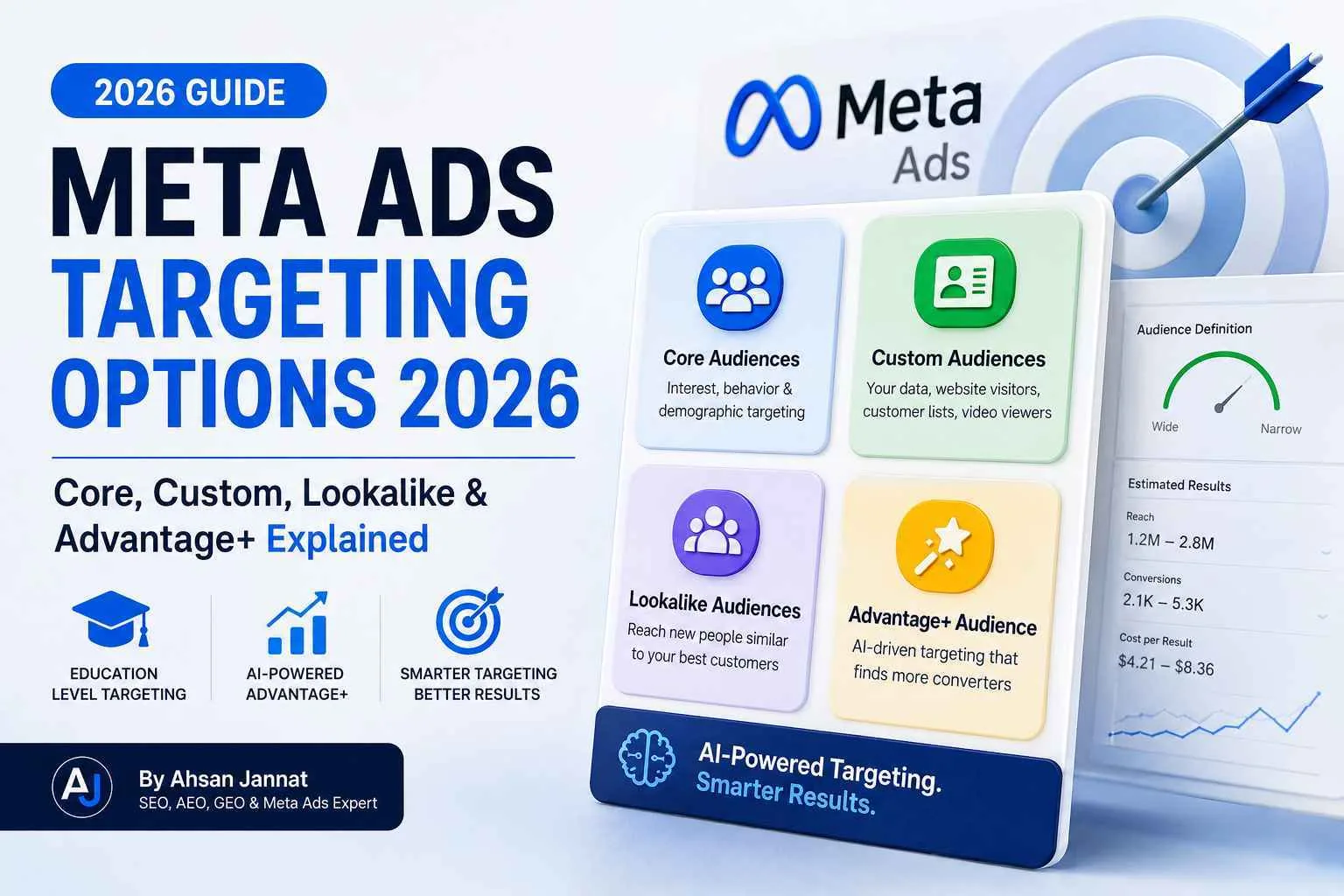
If you've read a Meta Ads targeting guide in the last 12 months and followed the advice, there's a good chance you've been doing it wrong. Not because the guide was inaccurate — but because Meta fundamentally changed how targeting works in 2026, and most guides haven't caught up.
This post covers every Meta Ads targeting option available in 2026 — including the demographic options (yes, including education level targeting that people keep searching for), the new Advantage+ AI mode, and the strategic framework for combining them. Based on real data from GSC performance and the latest Meta platform changes.
New to Meta Ads targeting? Read our Meta Ads Complete Guide 2026 first — it covers the full campaign structure. This post goes deep specifically on the targeting layer.
How Meta Ads Targeting Changed in 2026
Three significant changes happened to Meta's targeting system in 2025–2026 that affect how every campaign is built:
Detailed Targeting Exclusions Removed (March 31, 2026)
Meta removed detailed targeting exclusions from all existing campaigns on March 31, 2026. You can no longer exclude specific interests from your audiences. The primary exclusion tool left is Custom Audience exclusions — which you should be using anyway.
Advantage+ Audience Becomes the Default
When creating new campaigns, Advantage+ Audience is now the default targeting mode. Meta's AI treats most of your targeting inputs as "suggestions" rather than strict rules — and will expand beyond them when the algorithm predicts better results.
Privacy Restrictions on Sensitive Custom Audiences
From September 2, 2025, Meta began proactively restricting custom audiences that could reveal sensitive information about users. Some audience segments you could build previously are no longer available or may be restricted based on targeting context.
Hard Controls vs Audience Suggestions: The Most Important Concept in 2026
This is the single most misunderstood aspect of Meta Ads targeting in 2026. Most advertisers think their targeting settings are instructions to Meta. They are not. They are suggestions.
In 2026, Meta's targeting inputs fall into two completely different categories:
| Input Type | What It Is | Meta Respects It? | Examples |
|---|---|---|---|
| Hard Controls | Absolute limits Meta must respect | Yes — strictly enforced | Location, language, minimum age, Custom Audience exclusions, Special Ad Category restrictions |
| Audience Suggestions | Directional inputs Meta may ignore | Partially — treats as starting signal | Age range, gender, interests, behaviours, demographics, Lookalike audiences, Custom Audiences (in Advantage+ mode) |
What this means in practice: When you set age 25–44, interests in "digital marketing," and female gender — Meta may still show your ad to a 58-year-old male who the algorithm predicts will convert. Your inputs steered the starting point. They did not define the boundary. The only way to enforce strict limits is through Hard Controls.
Core Audiences: Every Targeting Option Listed
Core Audiences (also called Detailed Targeting) let you define who sees your ads based on demographics, interests and behaviours. In Advantage+ mode, these are suggestions. In Original Audience mode, they are stronger filters — though still not absolute.
Demographics — The Full List
These are the demographic targeting options available in Meta Ads Manager in 2026. This is the complete breakdown people search for (particularly education level targeting, which shows up in your top GSC queries):
| Category | Options Available |
|---|---|
| Age | 18–24, 25–34, 35–44, 45–54, 55–64, 65+ (or custom range). Minimum age can be set as a Hard Control. |
| Gender | All, Men, Women. Note: in Special Ad Categories (housing, credit, employment), gender targeting is restricted. |
| Location | Country, state/region, city, postal code, radius around a point. Hard Control — strictly enforced. |
| Language | Target people who use Facebook in a specific language. Hard Control. |
| Education Level | High school grad, in college, college grad, in grad school, master's degree, professional degree, doctorate. Available under Demographics → Education → Education Level. |
| Field of Study | Target people by their studied subject (e.g. computer science, medicine, marketing). |
| Schools | Target people who attended specific universities or schools. |
| Job Title | Target by self-reported job title. Variable accuracy — people enter titles inconsistently. |
| Industry | Target by industry: technology, healthcare, finance, education, retail, etc. |
| Relationship Status | Single, in a relationship, engaged, married, divorced, widowed. Useful for wedding and relationship-related products. |
| Life Events | Recently moved, new job, newly engaged, newly married, recently divorced, away from hometown, long-distance relationship, anniversary within 30 days. High purchase-intent moments. |
| Parents | All parents, parents of toddlers, parents of early school age, parents of pre-teens, parents of teens, expecting parents. |
| Political Views | Very liberal, liberal, moderate, conservative, very conservative. US only. Restricted in many contexts. |
| Generation | Baby boomers, Gen X, Millennials, Gen Z. |
Education level targeting in practice: If you're running ads for an executive MBA programme, combining "Master's degree or higher" + "Job title: Manager/Director" + relevant industries creates a tight qualification filter. However, use this in Original Audience mode — Advantage+ will expand beyond it regardless of educational qualification.
Interests — How They Actually Work in 2026
Interest targeting has fundamentally changed. When you select an interest, Meta treats it as a probabilistic signal, not a filter. The platform assigns interests based on pages users liked, content they engaged with, and topics Meta infers from behavioural patterns.
Key reality checks for 2026:
- Interest pools overlap heavily — someone interested in "SEO" also likely shows as interested in "digital marketing", "content marketing" and "Google Analytics"
- Stacking 10 interests in one ad set doesn't make your targeting more precise — it widens the potential audience
- The most effective use of interests is as a starting signal for early-stage accounts with limited Pixel data, not as a long-term targeting strategy
- Once you have 50+ conversion events, switching to broad targeting or Advantage+ almost always outperforms interest stacking
Behaviours
Behaviours target based on actual actions Meta can observe or infer — purchase behaviours, device usage, travel patterns and digital activities. These tend to be more performance-relevant than interests because they reflect actions, not just stated preferences.
| Behaviour Category | What It Targets | Best Use Case |
|---|---|---|
| Purchase behaviour | Engaged shoppers, frequent buyers, online purchasers by category | E-commerce — high purchase intent |
| Digital activities | Page admins, game players, event creators | B2B, SaaS, community products |
| Travel | Frequent travellers, currently travelling, returned from trip | Travel, hospitality, visa services |
| Device/OS | iOS users, Android users, specific device models | App advertisers, device-specific offers |
| Expats & multicultural | Expats by country of origin, bilingual users | Remittance, migration, language products |
| Charity donors | Likely to donate to charity (various categories) | Nonprofit fundraising — relevant to your GSC "charity nonprofit" query |
Custom Audiences: Your Highest-Converting Asset
Custom Audiences are built from your own first-party data. They are the highest-converting audience type in the Meta ecosystem because they target people who already know you — and in 2026, first-party data is more valuable than ever as third-party targeting options continue to be restricted.
Website Custom Audiences
Built from your Meta Pixel data. Retention windows up to 180 days (up to 2 years for purchase events).
Cart Abandoners (1–7 days)
People who added to cart but didn't purchase. The hottest retargeting segment that exists — they've already made the buying decision once. Target with urgency messaging and a specific incentive.
Specific Page Visitors
People who visited your pricing page, services page, or product page but didn't convert. Target by URL — e.g. "visited /pricing but NOT /thank-you". Segment by page to match ad creative to exactly what they viewed.
All Website Visitors (30–60 days)
Broad retargeting audience for brand reminder and value proposition ads. Less specific than page-based audiences but much warmer than cold traffic. Use for middle-of-funnel content.
Repeat Visitors
People who visited your site 2+ times. Repeat visits signal genuine research intent. This audience converts at significantly higher rates than first-time visitors and responds well to direct conversion offers.
Customer List Custom Audiences
Upload your CRM data — email addresses, phone numbers, names. Meta matches against user accounts at 40–60% match rates. The most powerful uses:
- Exclude existing customers from acquisition campaigns to stop wasting budget
- Seed a Lookalike from your best buyers — this is the highest-quality Lookalike source
- Re-engage lapsed customers with win-back campaigns
- Cross-sell to customers who bought Product A but not Product B
Engagement Custom Audiences
| Source | Retention Window | Best Use |
|---|---|---|
| Facebook Page engagers | Up to 365 days | Retarget social followers with direct offers |
| Instagram account engagers | Up to 365 days | Same — high brand awareness, lower purchase intent than website visitors |
| Video viewers (25/50/75/95%) | Up to 365 days | Build warm audiences cheaply via Video Views campaigns, then retarget |
| Lead form openers (not submitted) | Up to 90 days | Re-engage people who showed intent but didn't convert |
| Lead form submitters | Up to 90 days | Exclude from lead campaigns; use for upsell/cross-sell |
| Instagram Shop visitors | Up to 180 days | Product retargeting for e-commerce with Instagram Shop |
Lookalike Audiences: Scalable Cold Traffic
Lookalike Audiences find new users who share characteristics with your best existing customers. You provide a source audience; Meta's algorithm analyses the patterns and finds similar users across its platform.
Lookalike Size: What the % Actually Means
| Lookalike % | Similarity | Volume | When to Use |
|---|---|---|---|
| 1% | Most similar | Smallest | Best quality, most targeted — start here always |
| 2–5% | Good similarity | Medium | When 1% audience is too small to exit learning phase |
| 6–10% | Broad similarity | Largest | Only for very large budgets — quality drops significantly |
Market size matters: In smaller markets like Bangladesh, a 1% Lookalike may only produce 50,000–100,000 users — too small for efficient delivery. In those cases, use 2–3% or combine with broad interest targeting to reach adequate volume.
Lookalike Source Quality Ranking
Purchasers / Paying Customers
The highest commercial intent signal. A Lookalike of people who paid you money tells the algorithm to find more people with the same buying behaviour. This is the most effective Lookalike source available.
High-Value Leads from CRM
If you can't separate purchasers, use your closed-deal leads or highest-quality leads. The more qualified your source, the more qualified your Lookalike will be.
Email List (Engaged Subscribers)
Active email subscribers have demonstrated interest and brand familiarity. Avoid uploading cold, purchased lists — low match quality, low Lookalike quality.
Website Visitors (30–60 Days)
Good volume, warm intent. Better than broad interests but lower commercial signal than purchasers. Useful when transaction data is limited.
Video Viewers (75%+ Completion)
Lowest cost to build, decent quality. People who watched nearly all of a video have shown genuine engagement with your brand — a meaningful signal at scale.
Advantage+ Audience: Meta's AI Targeting Mode
Advantage+ Audience is Meta's fully algorithmic targeting mode — and it is now the default for all new campaigns. Understanding how it actually works is critical because it operates fundamentally differently from every other targeting option.
How Advantage+ Audience Works
When Advantage+ Audience is on, Meta treats all your targeting inputs (interests, demographics, Lookalikes, Custom Audiences) as "audience suggestions" — directional hints the AI uses as a starting point. The system is free to show your ad to anyone it predicts will achieve your campaign objective, including people completely outside your defined audience.
Advantage+ vs Original Audiences: In Advantage+ mode, your audience inputs are hints. In Original Audience mode, they're treated as stronger filters (though still not absolute for most input types). New campaigns default to Advantage+ — you must manually switch to use Original Audiences.
When Advantage+ Audience Works Best
- Accounts with strong Pixel data (50+ conversion events per week per ad set)
- Scaling campaigns where you've already identified winning creative
- E-commerce with Catalogue/Dynamic Product Ads
- Awareness and Traffic campaigns where broad reach is acceptable
- Accounts with clean first-party data as audience suggestions
When to Use Original Audiences Instead
- New accounts with no Pixel conversion history — give the algorithm a stronger signal
- Retargeting campaigns where you want to target ONLY specific warm audiences (cart abandoners, pricing page visitors)
- B2B campaigns requiring specific job title or industry targeting
- Nonprofit or charity campaigns with strict eligibility criteria
- Any campaign where reaching outside your audience definition would be wasteful or inappropriate
Advantage+ Shopping Campaigns (ASC)
For e-commerce specifically, Advantage+ Shopping Campaigns automate the entire campaign structure — targeting, placement, and some creative elements. Meta's data shows ASC often outperforms manually built shopping campaigns by 15–30% ROAS. Worth testing once you have a product catalogue and sufficient Pixel purchase data.
Which Audience Type to Use — Decision Framework
| Situation | Recommended Audience Type | Why |
|---|---|---|
| New account, no Pixel data, low budget | Core Audiences (Original mode) with 3–5 interests + location | Gives algorithm a starting signal without needing conversion history |
| New account, have customer email list | 1% Lookalike from email list + Core exclusions | Leverages existing customer knowledge immediately |
| Account with 50+ conversions/week | Advantage+ Audience with Custom Audience as suggestion | Algorithm has enough data to self-optimise; manual targeting limits performance |
| Retargeting warm audience | Website Custom Audience (Original Audience mode) | You want tight control — only retarget people who already know you |
| Scaling a proven campaign | Advantage+ Audience (no audience suggestion) | Broadest reach; algorithm finds converters at scale |
| B2B with specific job criteria | Core Audiences — job title + industry (Original mode) | Meta's AI rarely matches B2B intent well without demographic direction |
| Charity/nonprofit with eligibility rules | Core Audiences (Original mode) + Custom Audience exclusions | Need strict controls; broad AI delivery wastes budget on ineligible users |
Why Creative is the New Targeting in 2026
This is the most important strategic shift in Meta Ads in 2026 — and most advertisers still haven't absorbed it.
When Advantage+ Audience is on, Meta's AI uses your creative as a targeting signal. The algorithm watches who engages with your ad and finds more people like them. This means your video hook, your opening line of copy, your visual — these are doing targeting work that interest stacking used to do.
"In 2026, the main limitation for Meta ads is not targeting, but creative volume and interpretation." — Andrew Foxwell, Meta Ads strategist
Motion's 2026 creative benchmark analysed over 550,000 ads across roughly $1.3 billion in spend and found only 5–8% of ads become real performance winners. The implication: you need volume of creative to give Meta's algorithm enough to learn from. More variants, more signals, better targeting — automatically.
Practical implications for your targeting strategy:
- An ad that opens "Business owners in Dhaka — this is for you" will out-target any interest segment in Advantage+ mode
- Persona-based creative acts as an audience filter — it naturally selects who stops scrolling
- Broad targeting + strong persona creative often outperforms narrow targeting + generic creative
- Test 5+ creative variants per campaign rather than 5+ audience segments per campaign
The 2026 Meta Ads Targeting Strategy That Works
Here is the complete targeting strategy framework for 2026, combining all audience types correctly at each funnel stage:
Build Your First-Party Data Foundation First
Before running any campaigns, install your Pixel, set up the Conversions API, and fire all standard events. Upload your customer list. This foundation determines the quality of every audience you'll build from here. Without it, you're targeting blind.
Top of Funnel — Seed Warm Audiences Cheaply
Run Video View or Engagement campaigns with Advantage+ Audience and no audience restrictions. Let Meta find the users most likely to watch or engage. This builds video engagement Custom Audiences at very low CPM — your future retargeting pool costs almost nothing to build this way.
Middle of Funnel — Qualified Interest Targeting
Use Core Audiences in Original mode with 3–5 relevant interests OR a 1% Lookalike from your customer list. Keep audience size 500,000+ (larger for Advantage+ mode). Drive traffic to your website to grow your Website Custom Audiences. Focus on landing page views, not link clicks.
Bottom of Funnel — Tight Custom Audience Retargeting
Use Website Custom Audiences in Original Audience mode. Segment by recency and action (cart abandoners 1–7 days, pricing page visitors 7–30 days, all visitors 30–60 days). Use exclusion audiences to prevent showing ads to people who already converted. This is your highest-ROAS campaign.
Scale — Advantage+ With Proven Creative
Once you have 50+ conversions/week and winning creative identified, switch your acquisition campaigns to Advantage+ Audience with your best Custom Audience as a suggestion. Let the algorithm self-optimise. Scale budget in 20% increments every 3–4 days.
6 Targeting Mistakes Destroying Your Meta Ads Budget
- Stacking too many interests in one ad set. Stacking 15 interests doesn't sharpen your targeting — it broadens it massively and mixes conversion signals. Use one interest group per ad set when testing, so you know what works.
- Using Advantage+ Audience for retargeting campaigns. If you're running a dedicated retargeting campaign to warm audiences, switch to Original Audience mode. Advantage+ will expand beyond your custom audience, wasting retargeting budget on cold traffic.
- Ignoring audience exclusions. Failing to exclude purchasers from acquisition campaigns and converted leads from lead gen campaigns means you're paying to reach people who can't convert again. Build exclusion audiences before launching, not after.
- Audience overlap between ad sets. Running multiple ad sets targeting similar audiences in the same campaign causes internal auction competition — you bid against yourself. Use Meta's Audience Overlap tool and consolidate overlapping ad sets.
- Targeting too narrow for Advantage+ mode. Setting a very narrow audience (under 200,000) in Advantage+ mode and expecting it to stay within that boundary. It won't. Either use Original Audience mode for tight targeting or accept that Advantage+ will expand broadly.
- Not refreshing Custom Audience lists. Your customer list uploaded 6 months ago doesn't include your last 6 months of buyers — who are your best Lookalike seeds. Update your Custom Audiences monthly. Stale data means stale targeting.
Conclusion: The Right Targeting Mindset for 2026
The shift in Meta Ads targeting from 2020 to 2026 is a shift from control to collaboration. You no longer dictate exactly who sees your ad. Instead, you provide the highest-quality signals you can — first-party data, strong creative, clear conversion events — and Meta's algorithm uses them to find the people most likely to convert.
The advertisers winning in 2026 are those who stopped fighting the algorithm and started feeding it better. Better Pixel data. Better customer lists. Better creative that naturally filters for the right audience. And the patience to let the learning phase complete before making changes.
Need help building a targeting strategy that actually works for your business? Book a free consultation — I'll audit your current account setup and map out exactly which audience types and targeting approach fit your budget, objective and market.
Need Help Setting Up Meta Ads Targeting That Actually Works?
Pixel setup, Conversions API, audience architecture, Advantage+ strategy — done for you.
Get a Free Meta Ads Consultation