The Security–SEO Connection
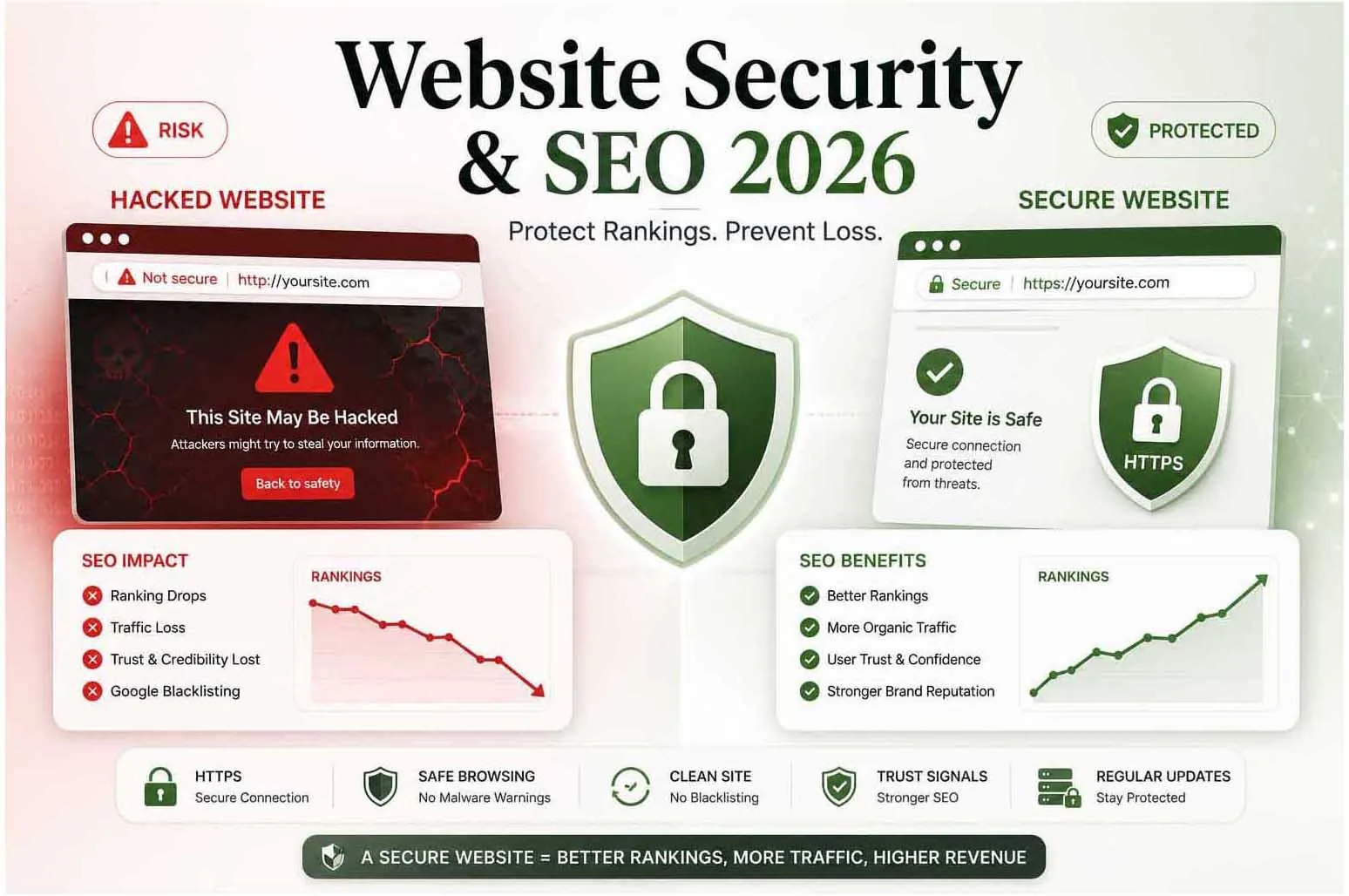
Most SEOs think of security as an IT concern separate from search rankings. This is a costly mistake. Website security directly impacts SEO in multiple ways — from ranking signals like HTTPS to catastrophic ranking losses after a hack.
As someone with a Computer Science background who works at the intersection of SEO and IT, I see this gap constantly. Businesses invest heavily in content and links, then lose everything overnight because of a preventable security lapse.
HTTPS as a Direct Ranking Signal
Google confirmed HTTPS as a ranking signal back in 2014, and its weight has only increased. In 2026, a site running on HTTP is not just technically outdated — it's actively penalised and flagged as "Not Secure" in Chrome browsers, crushing user trust and increasing bounce rates.
- SSL certificate is valid, from a trusted authority, and not expired
- All HTTP URLs redirect to HTTPS with a 301 redirect
- No mixed content warnings (HTTP resources loaded on HTTPS pages)
- HSTS (HTTP Strict Transport Security) header is configured
- Certificate covers all subdomains (wildcard SSL if needed)
Free SSL is fine: Let's Encrypt provides free, Google-trusted SSL certificates. There is no SEO advantage to paid SSL certificates — the ranking signal is binary (HTTPS or not).
What Happens When You Get Hacked
A website compromise triggers a cascade of SEO damage:
Google Detects the Malware
Google's crawlers typically detect malware within 1–7 days of infection. Once detected, the site is flagged in Google Search Console under "Security Issues."
Safe Browsing Warnings Appear
Chrome displays a full-page "This site may be dangerous" warning to all visitors. Click-through rates drop to near zero. Even users who know you may not proceed.
Rankings Drop or Disappear
Google may de-index infected pages or demote them significantly. Spam pages injected by hackers (typically pharmaceutical or gambling content) compete with your legitimate pages.
Recovery is Slow
Even after cleaning the malware and submitting a reconsideration request, full ranking recovery typically takes 60–180 days. Trust, once lost, is rebuilt slowly.
Security Signals Google Looks For
| Signal | SEO Impact | Priority |
|---|---|---|
| HTTPS / SSL | Direct ranking signal | Critical |
| No malware / safe browsing clean | Prevents de-indexing and warnings | Critical |
| No spam injections | Prevents manual penalties | Critical |
| Security headers (CSP, HSTS) | Indirect — prevents attack vectors | High |
| Clean server logs | Ensures proper crawling | Medium |
| Access control (no sensitive file exposure) | Prevents data leaks | Medium |
Security SEO Checklist
- HTTPS enforced site-wide with valid SSL certificate
- WordPress (or CMS) core, themes, and plugins are fully up to date
- Default admin usernames changed, strong passwords enforced
- Two-factor authentication enabled for all admin accounts
- File permissions correctly set (755 for directories, 644 for files)
- Web Application Firewall (WAF) active — Cloudflare, Wordfence, or similar
- Automated malware scanning enabled and alerts configured
- Regular backups stored off-site and tested monthly
- Sensitive files (.htaccess, wp-config.php) are not publicly accessible
- Google Search Console Security Issues tab checked weekly
Ongoing Security Monitoring
Security is not a one-time fix — it's an ongoing process. Set up these monitoring measures and check them regularly:
- Google Search Console — Check "Security Issues" tab weekly. Google will email you if malware is detected, but don't rely solely on that.
- Google Safe Browsing Transparency Report — Search your domain at safebrowsing.google.com/safe-browsing/report to check your current status.
- Sucuri SiteCheck — Free external malware scanner. Run monthly or after any plugin updates.
- Uptime monitoring — A sudden drop in uptime can indicate a DDoS attack or server compromise. Tools like UptimeRobot are free.
Conclusion
Security is SEO infrastructure. It doesn't earn rankings on its own, but a security failure can erase everything you've built — overnight. The investment required to maintain basic website security is minimal compared to the cost of recovering from a hack.
If you haven't done a security audit in the last 6 months, do one today. Start with HTTPS, then CMS updates, then WAF implementation. These three steps alone prevent the vast majority of attacks that compromise websites.
Worried a Hack Could Tank Your Rankings?
Security audits, malware cleanup, and hardening — so a breach never costs you the rankings you've worked for.
Get a Free Security Consultation