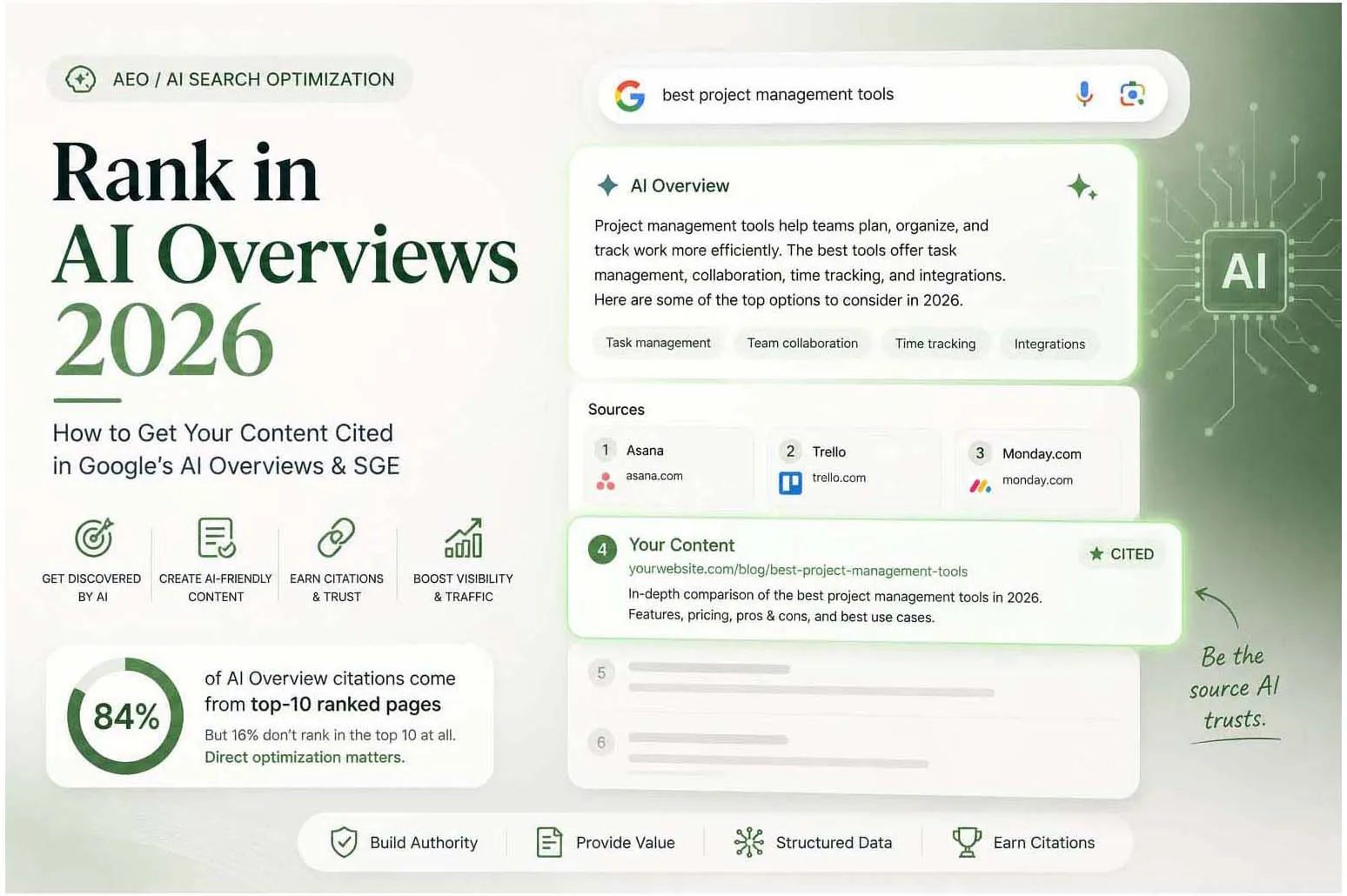
What Are Google AI Overviews?
Google AI Overviews are AI-generated summaries appearing at the top of search results. Instead of showing ten blue links, Google synthesizes an answer and cites sources below it. This reshapes who gets visibility and when.
Why AI Overviews Matter for Your Traffic
Early data shows AI Overviews reduce click-through rates for informational queries. However, sources cited in the overview still receive high-quality clicks — users who click are more intentional and convert better.
Note: Not all queries trigger AI Overviews. They appear most for informational "how to" queries. Commercial and transactional queries are less affected.
How Google Selects Sources
Google favours content that demonstrates E-E-A-T (Experience, Expertise, Authoritativeness, Trustworthiness). The AI pulls from pages that directly answer the query, use clear structure, include real data, and have strong backlink authority.
Step-by-Step Optimization Guide
Identify AI Overview Trigger Queries
Search your keywords incognito. Note which show AI Overviews. Target those for optimization first — biggest visibility opportunity.
Write a Direct Answer First
Put a 40–60 word direct answer in your first two paragraphs. Format: "The answer to [X] is [Y] because [Z]." Google's AI pulls from these.
Structure Headings as Questions
Use H2/H3 headings that mirror "People Also Ask" questions. This signals topical depth and makes structured extraction easy for AI.
Add a FAQ Section
Include 4–6 concise Q&A pairs at the bottom of your post. Mark up with FAQPage schema. Keep answers under 60 words each.
Strengthen E-E-A-T Signals
Add a credible author bio, cite real data sources, include publish/update dates. Google trusts pages that demonstrate real expertise.
Schema Markup That Helps
| Schema Type | What It Does | Priority |
|---|---|---|
| FAQPage | Marks up Q&A for direct extraction | High |
| Article | Signals content type, author, date | High |
| HowTo | Marks up step-by-step processes | Medium |
| BreadcrumbList | Improves context understanding | Medium |
| Person | Builds author entity and E-E-A-T | Medium |
How to Monitor Your AI Overview Presence
- Search target queries in incognito and check for your citations
- Use SEMrush AI Overview tracker or BrightEdge for automation
- Watch CTR changes in GSC — a drop may indicate an Overview is capturing clicks
- Monitor branded queries — appearing in your own brand's Overview means strong E-E-A-T
Common Mistakes That Keep You Out of AI Overviews
- Burying the answer. If the direct answer to the query isn't in the first 1-2 sentences after a heading, Google's extraction model often skips the page entirely in favor of a competitor that leads with it.
- Writing for keywords instead of questions. AI Overviews are built by matching content to a question, not a keyword string. Headings phrased as actual questions ("What is X?" not "X Guide") extract more reliably.
- Skipping schema on informational content. Article and FAQPage schema aren't just for rich snippets — they give the extraction model an explicit signal about what's a question and what's an answer.
- No clear author or source signal. Google favors citing pages with visible authorship and topical credibility over anonymous or thin-bio content, especially for YMYL-adjacent queries.
- Stale content on fast-moving topics. AI Overviews weight recency heavily for anything tied to a specific year or current best practice — an undated or unmaintained page loses ground quickly.
Conclusion
Ranking in Google AI Overviews requires clear structure, direct answers, strong E-E-A-T, and proper schema — the same fundamentals as great SEO, applied more deliberately. Start with your highest-traffic informational pages and work through this checklist systematically.
Need Help with SEO, AEO or GEO?
Let's build a visibility strategy that works across Google, AI answers and generative search.
Start a Free Consultation