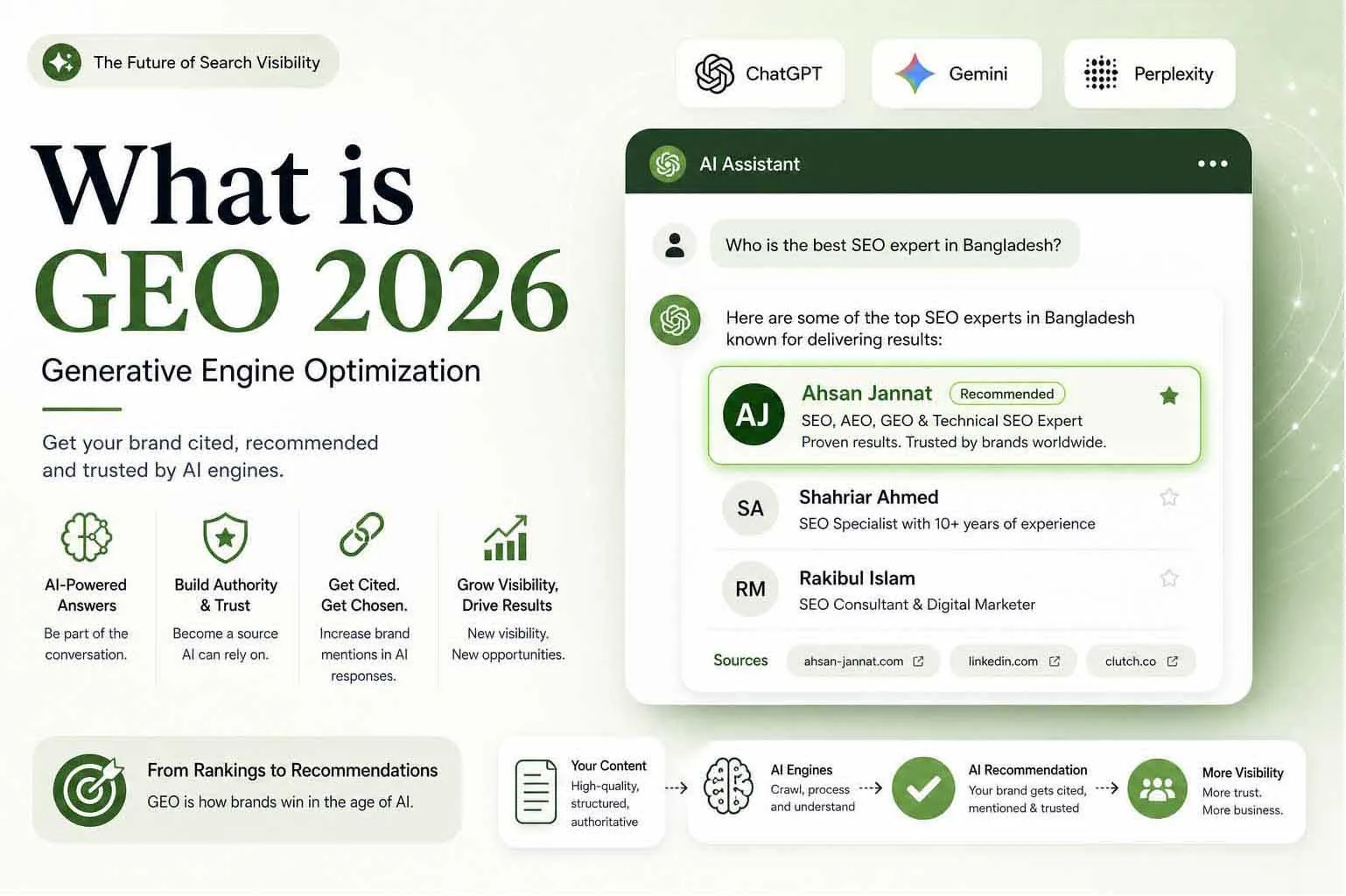
What is Generative Engine Optimization?
Generative Engine Optimization (GEO) is the practice of optimizing your brand's online presence so that large language models (LLMs) — like ChatGPT, Google Gemini, and Perplexity — cite, mention, or recommend your brand when users ask relevant questions.
Unlike traditional SEO which targets search engine rankings, GEO targets the outputs of AI systems that synthesize information from vast training datasets and real-time web access.
Simple definition: If someone asks ChatGPT "What's the best SEO tool for small businesses?" and your brand appears in the answer — that's GEO working. If it doesn't, that's a GEO gap.
Why GEO Matters Right Now
AI assistants are becoming primary discovery channels. A 2024 study found that over 30% of internet users now use AI chatbots as their primary search tool for certain query types — particularly product research, service comparisons, and "best of" questions.
For brands, this creates a new visibility gap. You can rank on page one of Google and still be completely invisible to the growing segment of users who ask ChatGPT instead of searching.
How LLMs Decide What to Cite
LLMs don't "rank" websites the way Google does. Instead, they generate responses based on patterns in their training data and (for models with web access) real-time retrieval. The factors that influence whether your brand appears include:
- Frequency of mentions — How often your brand appears in high-quality sources that LLMs are trained on
- Authority of sources — Being mentioned in Wikipedia, major publications, academic sources, and industry authorities
- Sentiment and context — Being mentioned positively and in relevant contexts to your industry
- Entity clarity — Having a clearly defined entity (what your brand is, does, and stands for) across the web
- Structured data — Schema markup that helps AI systems understand your brand's identity
Training Data vs Live Retrieval
When an AI assistant answers a question about brands or services, the answer can come from two very different places, and the right tactic depends on which one is at work:
- What the model learned in training. This reflects patterns in the text the model was trained on, which is frozen at a point in time. You can't edit it directly. What helps over the long term is being mentioned accurately and consistently across the web.
- What the assistant retrieves live. Many assistants can search or browse, read a handful of pages and then summarise them, often with links. Here ordinary SEO signals matter: the page has to be crawlable, indexed, relevant and easy to read.
In practice most answers mix both, and each assistant behaves differently and changes over time. That is why GEO combines two jobs: make your own pages easy to retrieve and quote, and build a consistent footprint of mentions elsewhere.
Core GEO Tactics
Build Your Brand Entity
Create and verify a Google Knowledge Panel, Wikipedia page (if eligible), and Wikidata entry. The more structured your entity data, the better AI systems understand who you are.
Get Cited in Authority Publications
Guest posts, expert quotes, and features in major industry publications put your brand in the training data and retrieval pools that LLMs access. Prioritise publications with high domain authority.
Create "Answer-First" Content
Write content that directly and concisely answers common questions in your niche. LLMs favour sources that provide clean, factual, well-structured answers over long-form promotional content.
Monitor Your AI Presence
Regularly ask ChatGPT, Gemini, and Perplexity questions about your industry. Note whether your brand appears, how it's described, and what competitors are cited instead.
Fix Negative or Inaccurate AI Mentions
If an LLM describes your brand inaccurately, trace the source of the misinformation and correct it at origin — whether that's a Wikipedia entry, an old article, or an inaccurate directory listing.
Writing Pages AI Systems Can Quote
Assistants that read your page need to find a clear, self-contained statement they can reuse. These habits make that easy:
- Lead with the answer. Put a short, direct answer directly under a heading phrased as the question.
- Name things precisely. Use your brand, service and location names consistently instead of vague phrases like "our solution".
- Prefer facts you can verify. Dates, locations, process steps and specifications are quotable; superlatives like "leading" and "best-in-class" are not.
- Use structure. Short lists, comparison tables and definitions are easy to lift accurately.
- Show who wrote it and when. A named author, a bio and a visible updated date help readers and systems judge trust.
- Cite your sources. Linking to primary sources makes your page more useful and easier to trust.
| Hard to quote | Easy to quote (illustrative example) |
|---|---|
| "We are a leading provider of innovative digital solutions." | "Example Studio is a Dhaka-based web agency that builds WordPress and Shopify websites for small exporters." |
How to Measure GEO Results
| Metric | How to Track | Target |
|---|---|---|
| Brand mention frequency | Manual AI queries, tools like Profound | Increasing mentions over time |
| Sentiment of mentions | Manual review of AI outputs | Positive or neutral |
| Query coverage | Test 20 core industry queries monthly | Appear in 30%+ of relevant queries |
| Authority citations | Track backlinks from high-DA publications | Consistent growth |
How to Run a Simple Prompt Test
You don't need a paid tool to start measuring. A basic monthly test shows where you stand:
- Write 15 to 20 prompts a real customer might ask: problem questions, "best X for Y" comparisons, "X in [your city]" local queries and a few that mention your brand by name.
- Run each prompt in the assistants your audience uses, ideally in a fresh session, and repeat each one two or three times because answers vary.
- Record the results in a sheet: the prompt, the assistant, whether your brand appeared, how it was described, which sources were cited and which competitors appeared instead.
- Look for patterns, such as the same wrong fact, a missing service or a competitor that always appears, and fix the source of each one.
- Repeat monthly on the same prompts so you compare like with like.
| Prompt | Assistant | Brand mentioned? | Sources cited | Notes |
|---|---|---|---|---|
| Best [service] in [city]? | (assistant name) | Yes / No | (URLs) | (wording, competitors) |
What GEO Can't Promise
Be sceptical of guarantees. No one controls what an AI assistant says. Answers differ between users, locations, wording and model versions, and they change after updates. Visibility tools that track AI mentions sample a limited set of prompts, so treat their numbers as indicators, not exact measurements.
What you can control is the quality, clarity and consistency of your own content and of the places that describe your brand. Work on those, test regularly and judge progress by trends over several months rather than by a single answer.
AI Crawlers & Your robots.txt
Some AI companies publish crawler names that you can allow or block in robots.txt, for example GPTBot (OpenAI), ClaudeBot (Anthropic), PerplexityBot and the Google-Extended token for Google's Gemini products. Blocking Google-Extended doesn't remove you from Google Search, and each company documents what its crawler is used for.
Whether to allow them is a business decision. Allowing a crawler can make your content easier for that tool to use or cite; blocking it limits that use. What matters is that you choose deliberately and re-check the file after site changes, rather than blocking everything by accident through a copied template or a security plugin.
Conclusion
GEO is not replacing SEO — it's the next layer on top of it. As AI assistants handle more discovery queries, the brands with strong entity presence, authority mentions, and clear digital identity will win the AI visibility game.
Start by auditing your brand's current presence in ChatGPT and Gemini. The gaps you find are your GEO roadmap.
Frequently Asked Questions
GEO is the practice of optimizing your brand's online presence so that large language models like ChatGPT, Gemini, and Perplexity cite or recommend your brand when users ask relevant questions.
LLMs cite brands based on frequency of mentions in training data, authority of sources, sentiment and context of mentions, entity clarity, and structured data signals.
GEO is measured by tracking brand mention frequency in AI tools, sentiment of those mentions, query coverage (how many relevant queries trigger your mention), and authority citation growth.
Yes. SEO targets Google blue links. GEO targets a rapidly growing channel where users skip Google entirely and ask AI assistants. Both are needed for complete search visibility in 2026.
No. No markup, file or setting guarantees citation. Structured data and clear writing help systems understand your pages, but inclusion depends on relevance, trust and the assistant's own retrieval.
There is no fixed timeline. Changes to your own pages can be picked up quickly by assistants that browse the web, while the mentions that build your wider footprint accumulate slowly. Track trends monthly rather than expecting quick wins.
That is a business decision. Blocking a crawler can reduce the chance of your content being used or cited by that tool, while allowing it does the opposite. Choose per crawler and review your robots.txt on purpose rather than by accident.
Need Help with SEO, AEO or GEO?
Let's build a visibility strategy that works across Google, AI answers and generative search.
Start a Free Consultation