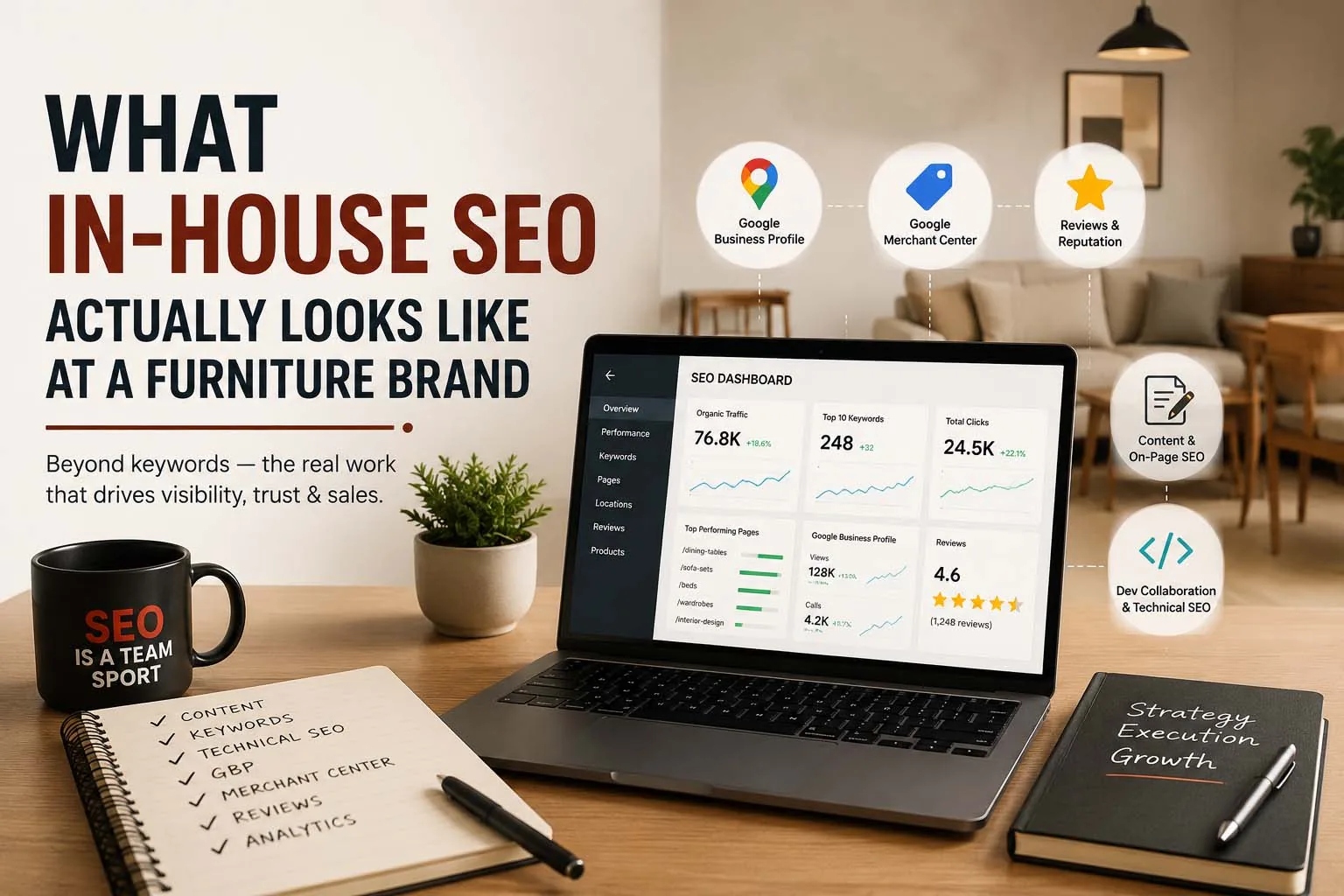
Most people outside the industry think "SEO" means writing some keyword-stuffed blog posts and hoping Google notices. I work as an in-house SEO, AEO, GEO and Meta Ads specialist at HATIL, one of the largest furniture and home goods brands in Bangladesh — and the actual job looks nothing like that.
This post is a straightforward account of what the role covers day to day: on-page content across product and category pages, monthly keyword tracking, Google Business Profile management across dozens of showroom locations, Google Merchant Center feed maintenance, a review-generation process tied to real showroom visits, and constant back-and-forth with the development team to get technical and trend-driven changes actually shipped.
Why write this: Most "day in the life of an SEO" content is generic. I wanted to write down what the role specifically involves at a multi-location retail brand with a physical showroom network and an active e-commerce catalog — because that combination changes what "SEO" actually means in practice.
What "In-House SEO" Actually Means
An SEO consultant working across many clients optimizes what they're given access to — usually just the website. An in-house SEO sits inside one brand full-time, which means the job expands to cover everything that affects how that brand is found and trusted online: the website itself, every physical location's local presence, the shopping feed, the review profile, and the relationship with whoever builds the site.
None of that is optional if the goal is genuinely showing up — a furniture brand with 70+ showrooms loses far more from an unoptimized Google Business Profile in one city than it gains from a single new blog post.
Content, FAQs & Meta Writing at Scale
The most visible part of the job is still content: writing and rewriting on-page copy, FAQ sections, and meta titles/descriptions across product and category pages. On a catalog site this isn't a one-off project — new categories, seasonal collections, and repositioned product lines all need the same treatment on an ongoing basis.
For example, category pages like living room furniture, bedroom furniture, and dining room furniture each need their own keyword-mapped copy, their own FAQ block answering the questions people actually search before buying, and a meta title/description pair that's unique — not a template swapped in across dozens of near-identical pages.
What the FAQ writing actually solves
- Answers the specific pre-purchase questions buyers search — material, warranty, delivery, care instructions
- Gives Google structured Q&A content that can be extracted for PAA boxes and AI Overviews
- Reduces pre-sale questions to customer support, since the page already answers them
- Creates natural long-tail keyword coverage without keyword-stuffing the main copy
In practice: meta information isn't written once and forgotten. Titles and descriptions get revisited whenever a category's positioning changes, a new competitor enters the search results, or click-through rate data in Search Console shows a page underperforming its ranking position.
Tracking Keyword Positions Every Month
Content decisions are only as good as the data behind them. Every month, keyword positions get tracked across the full set of target terms — not just a handful of "money" keywords, but the long tail of specific product and category searches that make up most of the actual search volume in furniture e-commerce.
This monthly tracking does two things: it shows which pages are gaining or losing ground so content can be revisited before a small decline becomes a real one, and it directly feeds the content-planning process for HATIL's separate blog — covered in the companion piece on running that content strategy.
Google Business Profile Across Every Showroom
This is the part of in-house SEO that a website-only consultant simply doesn't touch, and it's a significant piece of the job at a brand built around physical showrooms. Each location needs its own Google Business Profile, kept accurate and complete — correct category, hours, photos, service areas, and posts — because Google's local ranking (the Map Pack) evaluates each profile largely on its own merits, not the brand's overall website authority.
Profile Completeness
Every field filled in accurately — category, attributes, service area, business description — since incomplete profiles are a direct disadvantage against fully-optimized competitor listings in the same area.
Consistent NAP Across Locations
Name, address, and phone details need to match exactly across every profile and every directory a location is listed in. Inconsistency across dozens of showrooms is one of the fastest ways to quietly undermine local trust signals at scale.
Regular Posts and Photo Updates
Active profiles — ones that post updates and add fresh photos regularly — are treated by Google as more trustworthy and current than static, "set and forget" listings.
Keeping Google Merchant Center Accurate
Google Merchant Center feeds the product catalog into Google Shopping — titles, images, prices, availability, and category data. It's an unglamorous part of the job, but a single feed error (a mismatched price, a missing GTIN, an out-of-stock item still marked available) can get products disapproved or pulled out of Shopping results entirely, silently cutting off a real traffic and revenue channel.
Maintaining it means regularly auditing the feed against the live site, fixing disapprovals as they appear, and keeping product data structured well enough that it doesn't just serve Shopping ads — it reinforces the same Product schema signals search engines use to understand the catalog.
Turning Showroom Visits Into Reviews
Review count, recency, and rating all factor into local ranking, but reviews don't build themselves. Part of the role is working review generation into the actual customer journey — tying review requests to real showroom visits and completed purchases rather than treating reviews as a separate marketing task disconnected from SEO.
This is deliberately not about volume for its own sake. A steady, genuine stream of recent reviews tied to real visits signals an active, trustworthy business far more than a large batch collected all at once — and it's the same principle covered in more detail in the local SEO Map Pack case study.
Feeding Trends Back to the Dev Team
SEO doesn't exist in isolation from development. New Google trends, algorithm shifts, Core Web Vitals changes, and technical opportunities (schema updates, new structured data types, page speed fixes) all need to get communicated clearly to the people who actually build and maintain the site — and prioritized against everything else on their roadmap.
Part of the job is translating "Google changed X" into a concrete, scoped request a developer can act on, and then following up to make sure it actually shipped. An SEO recommendation that never reaches implementation has no value, no matter how correct it is.
Why This Combination Is the Job
None of these six areas — content, keyword tracking, GBP, Merchant Center, reviews, and dev collaboration — replaces the others. A perfectly optimized website with neglected Google Business Profiles across 70+ showrooms still loses local search visibility. A great Merchant Center feed with thin category content still underperforms in organic search. The actual job is running all of them together, continuously, not treating any one as "done."
Frequently Asked Questions
It spans on-page content and meta writing, monthly keyword position tracking, Google Business Profile management across locations, Google Merchant Center feed maintenance, review generation strategy, and ongoing communication with the development team to implement technical and trend-based changes.
In-house SEO means working full-time inside one brand rather than managing SEO as one of several client accounts, which allows faster iteration with developers, deeper product and catalog knowledge, and closer integration with channels like Meta Ads, GBP, and Merchant Center that an outside consultant often can't touch.
Each physical showroom needs its own accurately optimized Google Business Profile to appear in local Map Pack results near that location. For a brand with dozens of showrooms, this becomes an ongoing management task rather than a one-time setup.
It's where a retailer's product catalog is fed to Google so products can appear in Google Shopping results. Keeping the feed accurate and policy-compliant is ongoing, since errors or disapprovals can silently pull products out of Shopping results.
Review count, recency, and rating all factor into local ranking. Tying review requests to real customer visits keeps the review profile active in a way that directly supports Google Business Profile performance, rather than treating reviews as unrelated to SEO.
Conclusion
None of this is glamorous, and most of it is invisible to anyone outside the role. But it's what "in-house SEO" actually means at a brand with a real product catalog and a real physical footprint — not a single specialty, but the ongoing coordination of several systems that all affect whether the brand gets found, trusted, and chosen.
Need Help with SEO, AEO or GEO?
Let's build a visibility strategy that works across Google, AI answers and generative search.
Start a Free Consultation