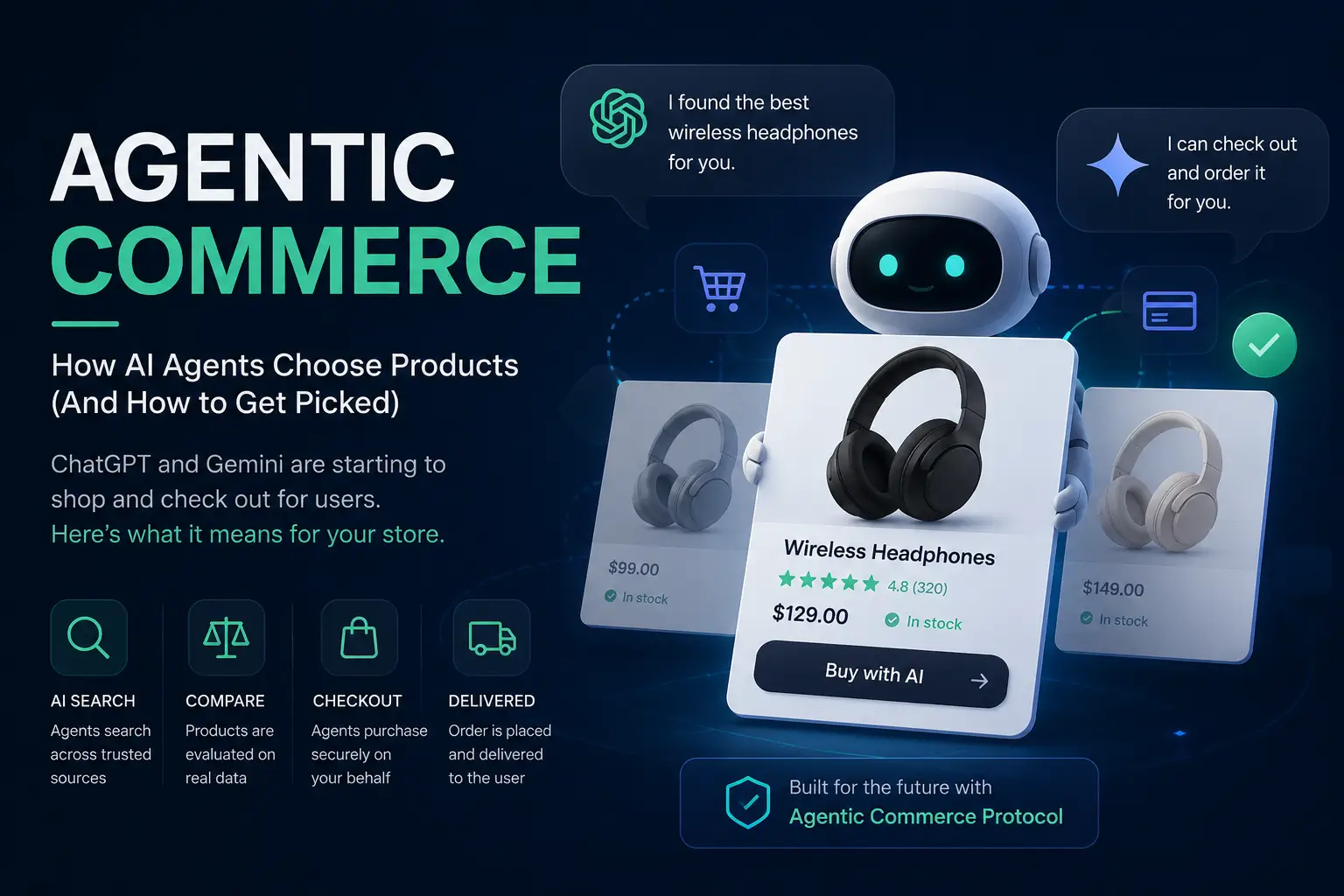
What Agentic Commerce Actually Means
For twenty-plus years, e-commerce SEO has meant one thing: get a human to click through to your website. Agentic commerce breaks that assumption. Instead of a person browsing your product pages, an AI agent acting on a shopper's behalf searches, compares, and in a growing number of cases, completes the purchase without a webpage ever being rendered to a human eye.
This isn't the same as an AI Overview citing your blog post. It's transactional: the agent is choosing a specific product, at a specific price, from a specific seller, and increasingly, actually paying for it.
Quick answer: Agentic commerce is AI systems like ChatGPT shopping and checking out for users, using structured product feeds instead of crawled webpages. It's live now through OpenAI's Agentic Commerce Protocol — product discovery is open to any merchant; in-chat Instant Checkout is currently limited to approved partners.
Suggested diagram: "User asks ChatGPT → agent checks product feed → Instant Checkout." Add your graphic at: blog/images/agentic-commerce-flow-diagram.webp
Why This Is Happening Right Now
This shifted from theoretical to live infrastructure within the last several months. A few concrete signals:
On the infrastructure side, OpenAI's Agentic Commerce Protocol (ACP) is live, with Instant Checkout in ChatGPT already rolling out to approved merchants using Stripe as the payment processor. Google and Shopify have separately been building toward a comparable open standard for agent-driven purchasing. None of this is a future roadmap item — it's shipping now.
How AI Agents Actually Choose a Product
This is the part that matters most for anyone running an online store, and it's a genuinely different ranking system than organic search:
- Structured feeds, not crawled pages. Agents don't browse your site the way Googlebot does. Merchants push a structured product feed (CSV, TSV, XML, or JSON) directly to the platform — this is a merchant-controlled push, not passive crawling.
- Freshness is a ranking input. Feeds can be updated as often as every 15 minutes. Stale pricing or a stock mismatch doesn't just look bad, it can get a product deprioritized or excluded entirely.
- Completeness beats cleverness. Required fields (identifiers, pricing, availability, fulfillment options) determine whether a product is eligible to be shown at all. Optional-but-recommended fields, like rich media and reviews, affect ranking once a product is eligible.
- No paid placement, for now. Non-Ads shopping results are not influenced by paid placement; they're ranked purely on feed quality and relevance. That could change, but today it rewards data hygiene over ad spend.
The Agentic Commerce Protocol, Explained Simply
You don't need to be an engineer to understand the shape of this, even if your dev team handles the implementation:
Product Feed
You, or your platform, send a structured file with your catalog: titles, prices, stock, images, shipping details.
Discovery
When a user's shopping intent matches your products, ChatGPT can surface them with images and details, pulled straight from your feed.
Checkout (Approved Partners)
If Instant Checkout is enabled, ChatGPT calls your systems to create a checkout session, but your servers still handle validation, tax, fraud checks, and the actual charge via your existing payment processor.
Confirmation
Your system accepts or declines the order and reports back; ChatGPT shows the result to the user.
The important nuance: OpenAI isn't becoming your payment processor or merchant of record. The checkout session is rendered inside ChatGPT, but the transaction itself still runs on your existing stack. That's a meaningfully lower lift than it sounds.
Worth knowing: Instant Checkout is currently gated to approved partners — you can't just flip a switch. But the product feed side, getting discovered and displayed, is open to any merchant today. That's the part almost nobody has optimized for yet.
How to Get Your Store Ready
If you're running Shopify, WooCommerce, or a custom stack, here's the practical starting point:
- Audit your existing product feed. If you already run Google Shopping, you likely have most of the required data structured — Google-compatible product data formats are supported.
- Fix the basics agents can't infer. Accurate real-time stock, consistent pricing across channels, and complete product identifiers. Agents penalize ambiguity far less gracefully than a human shopper would.
- Treat product titles as machine-readable, not just persuasive. "Coffee Beans" tells an agent almost nothing useful; a title with brand, variant, size, and roast level gives it something to match against real intent.
- Register early. Merchant sign-up for OpenAI's commerce program happens at chatgpt.com/merchants — getting your feed validated now means you're ready before this becomes standard practice.
Suggested graphic: a before/after comparison of a "thin" vs. "agent-ready" product feed row. Add your graphic at: blog/images/agentic-commerce-feed-comparison.webp
Does This Replace Traditional SEO?
No, and this is where most "AI will kill SEO" takes get it wrong. Traditional SEO and AEO still govern something agentic commerce doesn't: whether an AI system trusts and recognizes your brand as a credible source in the first place. Agentic commerce governs a narrower, later-stage decision — which specific product gets chosen once an agent is already shopping.
In practice, the two now run in parallel. You still need the content-and-authority layer covered in what GEO actually is and how to rank in AI Overviews. Agentic commerce is the newest, most transactional layer on top of that, and right now, almost nobody in most verticals has optimized for it, which is exactly why it's worth doing early.
Conclusion
Agentic commerce is not a 2027 prediction. The protocols, checkout flows, and feed specs are live today. The stores that treat their product feed as seriously as their website will be the ones AI agents actually surface when a customer says "find me the best X." Everyone else is still optimizing purely for humans in a market that's quietly starting to shop by proxy.
Want Help Getting Agent-Ready?
Let's audit your product feed and structured data so AI shopping agents can actually find and choose you.
Start a Free Consultation