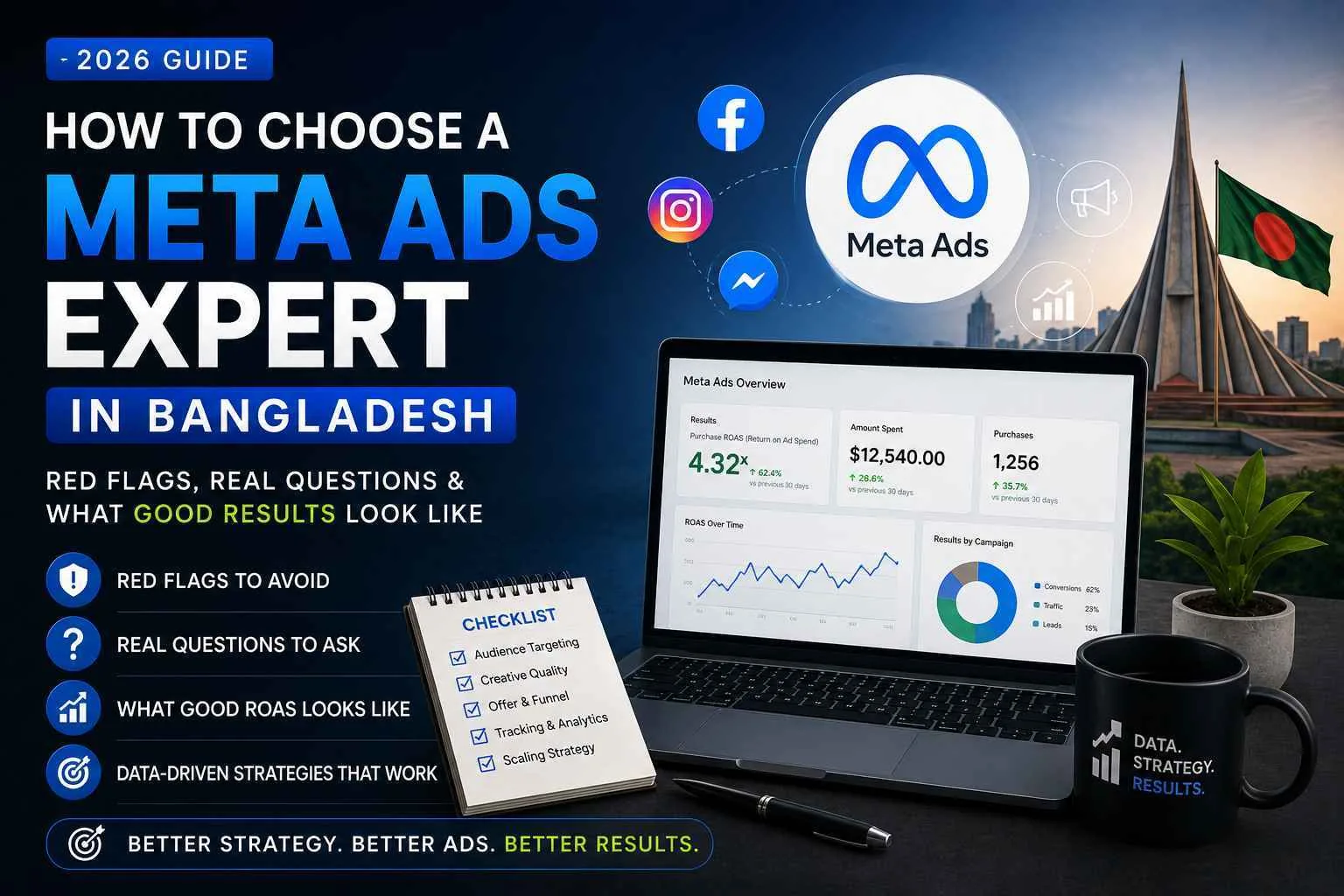
Why Most Meta Ads "Experts" Underdeliver
Meta Ads has a low floor to get started and a high ceiling to actually do well. Almost anyone can launch a campaign from a phone in ten minutes — which is exactly why the market is full of people calling themselves Meta Ads experts after boosting a few posts for a friend's shop. Running ads and running ads profitably, at scale, with a real funnel are different skill levels entirely.
Same approach as choosing an SEO expert: don't look for the loudest claim. Look for verifiable process and real account data.
Red Flags to Watch For
"Boosting posts" is the whole strategy
The Boost button is a simplified, lower-control version of advertising. If that's the extent of the plan, you're not getting real campaign management.
No mention of the Conversions API
With iOS privacy changes, pixel-only tracking misses a meaningful share of conversions. Anyone not talking about server-side tracking is working with incomplete data.
No creative testing process
Running one ad creative until it fatigues, then replacing it reactively, isn't a testing strategy — it's guessing with a bigger budget.
Reports show spend, not ROAS
"We spent your budget" is not a result. A real report ties spend to return — ROAS, cost per lead, or revenue — not just reach and impressions.
Questions to Ask Before You Hire
- Can you show a real before/after from an actual ad account — spend, ROAS, and revenue, not just reach?
- How do you structure a full funnel (cold, warm, retargeting) rather than running one flat campaign?
- What's your creative testing process, and how often do you refresh creative?
- Do you use the Conversions API alongside the pixel?
- What reporting will I actually receive, and how often?
Who Should Own the Ad Account?
This is one of the most important questions and one of the least asked. Your ad account, pixel or dataset, domain verification and product catalog should sit inside your business portfolio (the setting formerly called Business Manager), with your specialist given partner or admin access.
- Continuity: if you change providers, your history, audiences and tracking data stay with you
- Transparency: you can see spend, results and billing directly in Meta instead of relying on a report
- Control: you decide who has access and can remove it at any time
Be cautious of anyone who runs your ads only from their own ad account and won't give you visibility. You can check who has access in your Business Settings.
Tracking to Check Before You Spend
Ads can't optimise well on bad data. Before a single rupee is spent, ask to see the tracking set up and tested:
- Pixel and Conversions API together, with events deduplicated so one purchase isn't counted twice
- Standard events such as Purchase or Lead firing correctly, checked with the Test Events tool in Events Manager
- Domain verification completed for your website
- Event match quality reviewed in Events Manager, since richer customer information helps Meta match conversions
- UTM parameters on ad links, so Google Analytics can compare Meta traffic with other sources
If many of your orders are cash on delivery, ask how confirmed orders will be reported back to Meta. Sending real, confirmed sales rather than every checkout attempt helps the system learn from genuine customers.
Budget and the Learning Phase
Meta's delivery system needs data. After you launch a campaign or make a significant edit, each ad set enters a learning phase while the system finds who responds. Meta's guidance is that an ad set needs roughly 50 optimisation events in a week to exit it.
- If your budget is small, run fewer campaigns and ad sets so each one gets enough data
- Avoid editing budgets, audiences or creative every day, which keeps resetting learning
- Judge results after a sensible period, not after the first few days
- Be wary of anyone who promises stable results immediately
What a Real Campaign Restructure Looks Like
A proper restructure isn't "make new ads." It typically involves rebuilding the account around four things at once: audience research (who's actually converting, not just who's engaging), a genuine full-funnel structure (separate campaigns for cold audiences, warm retargeting, and cart abandonment), fresh creative variations tested against each other rather than run on gut feel, and Conversions API tracking layered on top of the pixel so the data itself is trustworthy.
Done separately, none of these four move the needle much. Done together, they compound.
What Good ROAS Actually Looks Like
A real, verifiable example: a fashion e-commerce brand came in spending on Meta Ads at a 1.1x ROAS — essentially breaking even after ad spend, with no real margin left. After a full campaign restructure, creative testing, and a proper retargeting funnel, ROAS reached 4.2x within 60 days, with revenue from paid social increasing 180% over the same period.
The full breakdown of this campaign is on the case studies page, alongside the SEO and AEO results.
Why Data Discipline Beats Creative Alone
Good creative gets attention. It doesn't fix a broken funnel, bad audience targeting, or untracked conversions. The accounts that actually scale profitably treat creative as one input among several — audience structure, tracking accuracy, and funnel logic all have to be right at the same time for the creative to have anything to compound on top of.
This is also where a technical background helps in ways that aren't obvious from the outside: setting up server-side Conversions API tracking correctly is closer to a development task than a marketing one, and most "ads experts" skip it entirely because it's outside their skill set — not because it doesn't matter.
What a Sensible Creative Test Looks Like
Testing isn't "make three ads and see". A useful test changes one thing at a time and defines success first:
| What to test | Examples | Judge it by |
|---|---|---|
| Hook | The first line or first three seconds of a video | Click-through rate and cost per click |
| Format | Static image, short video, carousel | Cost per result |
| Offer | Discount, free shipping, free consultation | Conversion rate and cost per result |
| Audience | Broad targeting versus a narrower interest or lookalike group | Cost per result and lead or order quality |
Retire clear losers, keep winners running and watch for fatigue: rising frequency, falling click-through rate and rising cost per result are the usual warning signs.
What a Good Meta Ads Report Contains
- Spend and results: purchases or leads, cost per result and ROAS where it applies
- A cross-check against your own data, comparing Meta's reported conversions with actual orders or CRM leads, because attribution models differ
- Breakdowns by campaign, audience, placement and creative so you can see what drives the result
- Learnings and next actions, not just numbers
A report that only shows reach, impressions and likes tells you the ads ran, not whether they made money.
Meta Ads Considerations in Bangladesh
- Billing: ask how payment, currency and any local taxes on ad spend are handled, so your budget doesn't contain surprises
- Language and creative: check that creative and copy suit your audience, whether English, Bangla or both
- Messaging flows: if customers usually order through Messenger or WhatsApp, ask how conversations and sales will be tracked
- Cash on delivery: make sure confirmed orders, not just attempted checkouts, feed back into your reporting
Conclusion
Anyone can spend your ad budget. The question worth asking isn't who claims to be the best Meta Ads expert in Bangladesh — it's who can show real account data, a genuine full-funnel process, and a track record of turning a break-even account into a profitable one. Ask the five questions above, and judge the answers, not the pitch.
You can see the full campaign breakdown on the case studies page, my background on the about page, or reach out directly to talk through your account.
Frequently Asked Questions
Management fees are typically separate from ad spend and usually start around $299 for a launch-level package (project-based or monthly, and negotiable), scaling with campaign complexity. Ad spend itself is a separate budget you control directly through Meta.
It depends heavily on margin and industry, but as a general benchmark, anything below 2x is typically barely profitable after costs, while 3-4x+ is a strong result for most e-commerce accounts. A campaign stuck near 1x ROAS for months usually signals a targeting or creative problem, not a platform problem.
The learning phase alone typically takes 3-7 days per ad set. Meaningful, stable performance data usually takes 2-4 weeks, and a real restructure (new funnel, new creative testing, retargeting setup) often takes 60 days to fully mature, as seen in real case results.
Either can work. What matters more is whether the specific person managing your account can show real before/after ad account data, not just claims, and whether they understand full-funnel strategy rather than only boosting posts.
Boosting a post is a simplified, low-control version of advertising aimed mainly at engagement. Real campaign management uses Ads Manager directly, with proper campaign objectives, audience research, the Conversions API, creative testing, and a structured retargeting funnel — the difference between spending money and investing it.
You should. Create your own business portfolio and ad account, then give your specialist partner or admin access. That way your history, pixel data and billing stay with you if you change providers.
The Conversions API sends conversion events from your server to Meta, alongside the browser pixel. It helps recover events the pixel misses because of browser restrictions, and it needs a setup that avoids double-counting.
Enough for each ad set to collect a steady flow of conversions, because Meta's delivery system needs data to optimise. If your budget is very small, run fewer campaigns and ad sets rather than spreading it thin.
Looking for a Meta Ads Expert in Bangladesh?
Let's look at your ad account together and find what's actually capping your ROAS.
Start a Free Consultation