The Numbers: How Much Organic Traffic Is Actually Disappearing
If your organic traffic has felt flatter over the past year despite rankings holding steady, the data backs up what you're seeing. This isn't isolated to one industry or one site — it's a broad, measured shift across the search landscape.
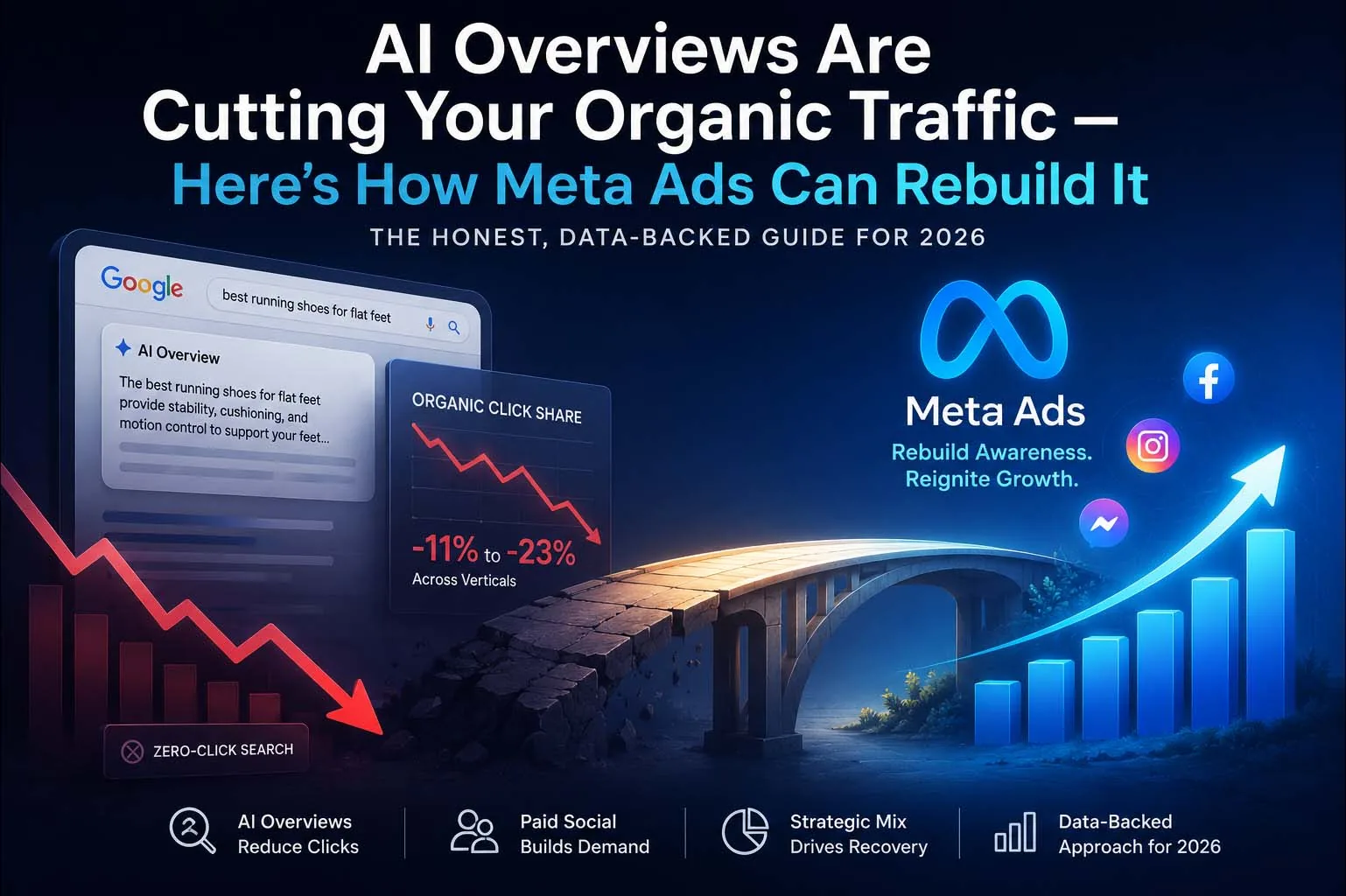
Seer Interactive's longitudinal study — tracking 53 brands across 5.47 million queries — found organic click-through rate on AI-Overview-present queries fell from a baseline of 1.76% to as low as 0.61% at the trough, a roughly 61% decline. Pew Research Center's behavioural tracking adds a sharper edge to this: when a user sees an AI Overview, about 1 in 4 sessions end entirely. That's not traffic moving to a competitor — it disappears from the web altogether.
To be fair to the other side: the same Seer Interactive data series found CTR partially rebounding in early 2026 as users learned to scan past AI summaries for a matching citation. The recovery is real, but the structural read is a new, lower baseline — not a return to pre-AI Overview normal.
Why This Isn't Going Away
Zero-click search isn't new — it's been building since Google introduced Knowledge Panels in 2012 and Featured Snippets in 2014. What's changed is the acceleration. Multiple 2026 analyses put the global zero-click rate at roughly 60% of all Google searches, climbing to around 77% on mobile. Gartner has forecast traditional search engine query volume dropping 25% by 2026 as AI chatbots absorb a growing share of queries that used to start with a Google search.
There's an encouraging counterpoint worth taking seriously: brands that do earn citations inside AI Overviews see real upside. ALM Corp's 2026 analysis found cited brands earn roughly 35% more organic clicks and 91% more paid clicks than non-cited brands on the same query. Being cited isn't just defensive — it appears to actively compound with paid performance.
The Honest Case for Meta Ads (Not a Silver Bullet, But Real)
Here's where a lot of "recover your lost SEO traffic" content overstates its case. The clearest documented budget shift in the data so far has gone toward paid search — text ads gaining 7 to 13 points of click share in the exact verticals where organic lost the most. Meta Ads are not a literal one-to-one replacement for a lost Google click, and any pitch that frames it that way isn't being straight with you.
The honest, defensible case for Meta Ads is different — and arguably more strategically important. One of the more striking findings in Bain & Company's B2B research is that 85% of buyers purchase from a "day one" vendor shortlist — a set of brands they had in mind before they ever searched. If AI Overviews are increasingly resolving the search moment itself, the businesses that win are the ones already on that shortlist when the search happens, not the ones hoping to be discovered fresh at the bottom of the funnel.
That's a brand-awareness problem, and it's exactly what Meta Ads are built to solve — reaching the right audience by interest, behaviour, and lookalike modelling, upstream of the moment an AI Overview might otherwise capture the click.
Where to Actually Point Your Budget
- Retarget the visitors you still get. Organic clicks that do arrive are increasingly higher-intent, since they clicked past an AI summary on purpose. A Meta retargeting audience built from these visitors is working with warmer traffic than a cold interest audience.
- Build top-of-funnel awareness for your category, not just your brand name. If buyers are forming their shortlist before they search, awareness campaigns need to reach them earlier — well before the moment of search intent, not just at it.
- Use lookalike audiences from your best existing customers. This is where paid social genuinely outperforms search: reaching people who resemble your buyers but haven't searched for you — or your category — yet.
- Don't abandon SEO to fund this. The data shows AI-citation status compounds with paid performance, not competes with it. Cited brands earn more from both channels simultaneously.
A Simple Framework for Reallocating Spend
Audit before you reallocate
Check Search Console: if clicks fell while impressions held steady, you're looking at click compression from AI Overviews, not a ranking or content problem. This distinction changes your entire response.
Identify your most AI-Overview-exposed queries
Cross-reference high-impression, low-click queries against terms where AI Overviews or AI Mode are triggering. These are your highest-priority pages for both GEO optimisation and a Meta Ads awareness push.
Build a retargeting layer immediately
This is the lowest-risk, fastest win — warm traffic you're already earning, now given a second and third touch through Meta.
Test a modest top-of-funnel awareness budget
Start small against a lookalike audience modelled on your existing customers, and measure branded search lift over 60–90 days rather than expecting immediate direct-response numbers.
Reinvest in AI-citation-worthy content in parallel
Structured, original, clearly-answered content is what earns the citation status that compounds both organic and paid performance, per ALM Corp's findings above.
Frequently Asked Questions
No, and any claim that they are should be treated with caution. The clearest documented budget shift so far has gone toward paid search (text ads), not paid social. Meta Ads play a complementary role — building brand awareness and consideration earlier in the buying journey, before AI Overviews ever answer the query — rather than recapturing the exact same clicks.
AI Overviews summarise an answer directly on the search results page, so many users get what they need without clicking through to any website. Multiple 2026 studies report organic click-through rate drops of roughly 60% or more on queries where an AI Overview appears, and a meaningful share of those searches end the user's session entirely.
The consensus across current industry analyses is that this is a structural shift rather than a temporary dip. Zero-click behavior has been rising for years due to featured snippets and knowledge panels, and AI Overviews have accelerated the trend significantly. Planning around a smaller, more competitive organic click pool is the more realistic approach.
Start by checking Google Search Console: if clicks fell while impressions stayed flat, you're likely seeing click compression rather than lost rankings. From there, prioritise earning AI citations through structured, authoritative content, and consider Meta Ads for top-of-funnel brand awareness so your business is already known before a prospect's search ever resolves inside an AI summary.
Conclusion
AI Overviews are a genuine, structural change to how much organic traffic is available to earn — not a temporary blip to wait out. But the data doesn't support treating Meta Ads as a direct swap for lost Google clicks. The honest strategy is narrower and more useful: retarget the higher-intent organic traffic you still get, build category awareness further up the funnel so you're already on the shortlist before the search happens, and keep investing in the structured, citable content that earns AI Overview mentions in the first place — because that's the one lever that appears to lift both organic and paid performance at once.
Need Both Sides of This Covered?
I work across SEO, GEO, and Meta Ads — which means your organic and paid strategy can actually be built together, not as two disconnected efforts. Let's talk.
Start a Free Consultation