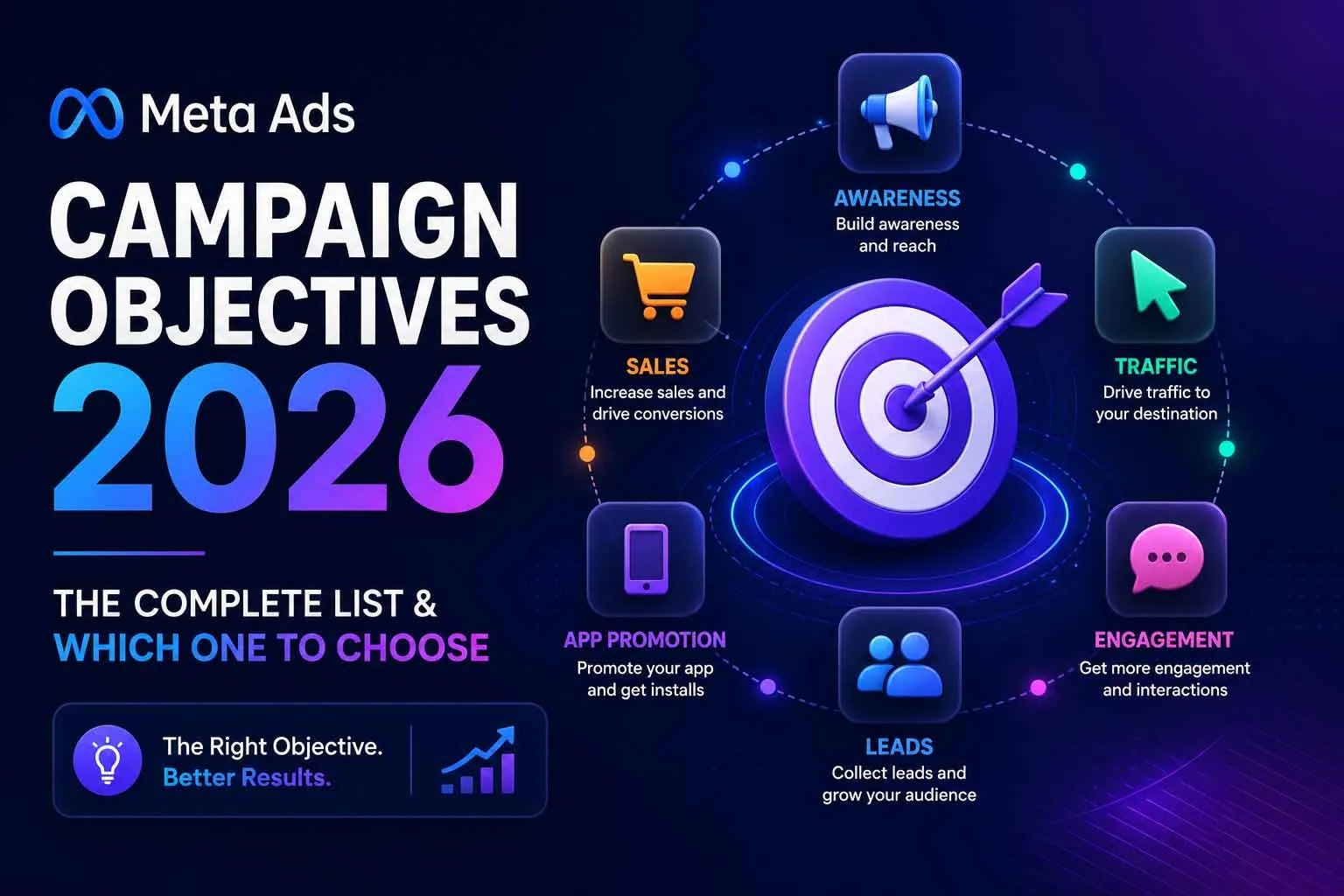
The campaign objective you select in Meta Ads is the single most consequential decision in your entire account. It determines who Meta's algorithm targets, how it optimises delivery, what actions it counts as success, and ultimately whether your budget produces results or evaporates.
Yet most advertisers choose their objective based on guesswork — picking what sounds right rather than understanding what each objective actually instructs the algorithm to do. This post covers every Meta Ads campaign objective available in 2026, exactly how each one works, and a clear decision framework for choosing correctly every time.
Part of the Meta Ads series: This post goes deep on objectives. For the complete campaign structure, audience strategy, and ROAS optimisation, read the Meta Ads Complete Guide 2026. For targeting options, see Meta Ads Targeting Options 2026.
Why Your Campaign Objective Changes Everything
When you choose a campaign objective, you are not just labelling your campaign. You are issuing a direct instruction to Meta's bidding algorithm about which users to target in the ad auction.
Meta's system finds people most likely to perform your chosen action by analysing billions of behavioural data points. The algorithm is exceptionally good at predicting specific behaviours — but only the behaviour you tell it to optimise for. Choose "Traffic" and it finds the best clickers. Choose "Sales" and it finds the best buyers. These are often completely different people.
The most expensive mistake in Meta Ads: Running a Traffic objective when you want conversions. Traffic campaigns optimise for clicks — they find people who click ads, not people who buy. Click-optimised audiences and purchase-optimised audiences share very little overlap. Switching a stagnant Traffic campaign to Sales often produces an immediate ROAS improvement with zero other changes.
The ODAX Framework: Meta's 2026 Objective Structure
Meta reorganised its campaign objectives under the ODAX (Outcomes-Driven Ad Experiences) framework. The six outcome categories map to the classic marketing funnel, but each contains sub-objectives that further refine what the algorithm optimises for.
| Objective | Funnel Stage | Primary Algorithm Goal | Conversion Event Required? |
|---|---|---|---|
| Awareness | Top | Maximise brand memory and reach | No |
| Traffic | Top–Middle | Send people to a destination | Optional (recommended) |
| Engagement | Top–Middle | Drive interactions with content | No |
| Leads | Middle–Bottom | Collect contact information | Yes (Lead or Custom event) |
| App Promotion | Bottom | Drive app installs or in-app events | Yes (SDK required) |
| Sales | Bottom | Drive purchases or conversions | Yes (Purchase, Lead, or Custom) |
Awareness Objectives
Awareness campaigns maximise how many people see your brand and how memorable that exposure is. The algorithm finds users most likely to recall your ad after seeing it — not most likely to click or convert.
Awareness Sub-Objectives
Brand Awareness
Optimises for "estimated ad recall lift" — the algorithm predicts which users are most likely to remember seeing your ad. Meta shows your ad to these users and spaces out delivery to maximise recall rather than just raw reach. Best for: brand launches, new market entry, campaigns where memory matters more than immediate action.
Reach
Maximises the number of unique people who see your ad within your audience, with frequency controls to prevent oversaturation. Unlike Brand Awareness, Reach does not optimise for memorability — it simply maximises unique exposure. Best for: local events, product launches where broad awareness matters, campaigns with very defined geographic targets.
When to Use Awareness
- Launching a brand new product or business with zero existing audience
- Entering a new geographic market where you are completely unknown
- Building an audience for future retargeting at minimum cost (video views from awareness campaigns seed cheap retargeting pools)
- Seasonal campaigns where you need to remind your existing market you exist
Critical caveat: Never use Awareness when you want leads or sales. The algorithm will not route your ad to likely buyers — it routes to likely rememberers. These are not the same people.
Traffic Objective
Traffic campaigns send people to a destination — your website, app, WhatsApp, or Messenger. The algorithm finds users most likely to click through.
Traffic Sub-Objectives
| Sub-Objective | Optimises For | Quality Level | Use When |
|---|---|---|---|
| Link Clicks | Raw clicks on your ad | Lowest — click-baiters and curiosity clickers | Almost never — Landing Page Views is always better |
| Landing Page Views | Clicks that result in page actually loading | Medium — filters out bots and abandoners | Driving qualified traffic to content or product pages |
| Conversations started via WhatsApp | High intent — direct conversation | Service businesses in WhatsApp-dominant markets (Bangladesh, Middle East) | |
| Messenger | Conversations started in Messenger | High intent | Customer service, product enquiries, consultation booking |
| Calls | Phone call initiations | Very high intent | Local businesses, urgent services, high-ticket products |
Always choose Landing Page Views over Link Clicks. Landing Page Views requires the Pixel to fire a PageView event — it only counts when your page actually loads in the user's browser. This filters out click-bait engagers, slow connections that don't load, and bots. The CPM is slightly higher but the traffic quality difference is significant.
When NOT to Use Traffic
Traffic is the most overused objective in Meta Ads. The algorithm optimises for people who click ads — which is a behaviour that correlates weakly with purchasing intent. If your goal is leads or sales and you have Pixel conversion data, Sales objective almost always outperforms Traffic for the same creative and audience.
Engagement Objective
Engagement campaigns drive interactions — likes, comments, shares, video views, page follows, and event responses. The algorithm targets users most likely to interact with your content rather than visit your website or convert.
Engagement Sub-Objectives
Post Engagement
Maximises likes, comments, shares and reactions on a specific post. Useful for building social proof before running conversion campaigns — a post with 300 comments converts better than the same post with 3. Run a small post engagement campaign to seed social proof, then retarget engagers with conversion ads.
Video Views
The highest strategic value Engagement sub-objective. Optimises for ThruPlay (full completion or 15+ seconds) or 2-Second Continuous Video Views. CPMs are very low compared to conversion objectives. Use this to build massive video engagement Custom Audiences cheaply — people who watched 75%+ of your video become your highest-converting retargeting segment.
Page Likes
Grows your Facebook Page following. Declining strategic value in 2026 as organic page reach has decreased, but still useful for businesses where social proof via follower count matters (hospitality, retail, local service businesses).
Event Responses
Drives "Interested" or "Going" responses to Facebook Events. Useful for physical businesses, event organisers, and webinar promoters who use the Facebook Events feature.
Leads Objective
The Leads objective collects contact information from interested users. It is the primary objective for service businesses, B2B companies, real estate, education, and finance — any business where the path to revenue involves a human sales conversation rather than an online checkout.
Leads Sub-Objectives Compared
| Sub-Objective | How It Works | Lead Volume | Lead Quality | Best For |
|---|---|---|---|---|
| Instant Forms | Native Meta form — user never leaves the app | Highest | Lower (less friction = less intent) | High-volume lead generation where you have good qualification follow-up |
| Website | Sends to your landing page form | Medium | Higher (more friction = more intent) | When landing page converts well and you want qualified leads |
| Messenger | Opens Messenger conversation | Medium | High (direct dialogue) | Products needing explanation; consultative services |
| Opens WhatsApp conversation | Medium-High | High | Bangladesh, Middle East, South Asia markets where WhatsApp dominates | |
| Calls | Initiates phone call directly | Low | Very High | Urgent services, high-ticket B2B, local businesses |
Instant Forms — Best Practices
Instant Forms collect leads at very low friction — users submit contact details without leaving Meta. Volume is high but quality can vary. To improve quality:
- Use "Higher Intent" form type (adds a review step before submission)
- Add qualifying questions (budget range, timeline, project type)
- Connect your CRM via Meta's native integrations or Zapier for immediate lead notification
- Follow up within 5 minutes — lead response rates drop by 400% after the first hour
- Include a clear value statement and privacy assurance in the form header
App Promotion Objective
App Promotion campaigns drive mobile app installs or in-app events. Requires SDK integration (Meta SDK, AppsFlyer, Adjust, etc.) to track in-app events and feed conversion data back to Meta's algorithm.
App Promotion Sub-Objectives
- App Installs — optimises for users most likely to install your app after clicking the ad
- App Events — optimises for users most likely to complete a specific in-app action (purchase, sign-up, level complete). Far more valuable than installs once you have enough event data
- Value Optimisation — for e-commerce apps, optimises for users likely to generate the highest lifetime value (requires purchase event data)
Not relevant for most service or e-commerce businesses without a mobile app. If you have an app, App Events objective consistently outperforms App Installs once 50+ events per week are tracked.
Sales Objective
The Sales objective is the most powerful option for businesses with active Pixel conversion data. It instructs Meta's algorithm to find users most likely to complete your defined conversion event — purchase, lead form submit, account registration, or custom event.
Sales Sub-Objectives
Conversions (Website)
The primary Sales sub-objective for most businesses. Meta finds users most likely to complete your chosen Pixel event on your website. Requires minimum 50 conversion events per week per ad set to exit learning phase. If you have fewer than 50 weekly purchases, optimise for a higher-funnel event like Add to Cart or Initiate Checkout, then shift to Purchase once volume increases.
Catalogue Sales (Dynamic Product Ads)
Automatically shows the right products to the right people based on their browsing and purchase history. Requires a product catalogue connected to your ad account. Exceptional for retargeting — shows users exactly the products they viewed or added to cart. One of the highest-ROAS campaign types available in e-commerce.
Messenger / WhatsApp Conversions
Optimises for conversion conversations initiated through Messenger or WhatsApp. For markets where buying decisions are made in chat rather than through a traditional checkout — common in South and Southeast Asia.
The Learning Phase — Why It Matters for Sales Campaigns
The learning phase is the period during which Meta's algorithm is gathering data to understand which users are most likely to convert for your specific campaign. It lasts until the ad set achieves 50 optimisation events.
| Learning Phase Status | What It Means | What To Do |
|---|---|---|
| Learning | Algorithm gathering data — performance unstable | Do not make significant changes — wait it out |
| Learning Limited | Not enough events to exit learning — under 50/week | Lower your optimisation event (e.g. Add to Cart instead of Purchase), increase budget, or broaden audience |
| Active | Learning complete — algorithm optimising efficiently | Scale carefully (max 20% budget increases every 3–4 days) |
Decision Framework: Which Objective to Choose
Use this framework based on your account situation — not based on what "sounds right":
| Your Situation | Correct Objective | Sub-Objective |
|---|---|---|
| Brand new business, zero audience | Awareness or Engagement | Video Views (cheapest warm audience builder) |
| No Pixel data, want website visitors | Traffic | Landing Page Views |
| Have Pixel, want leads (service business) | Leads | Instant Forms (high volume) or Website (high quality) |
| E-commerce, have Pixel + 50+ purchases/week | Sales | Conversions → Purchase event |
| E-commerce, fewer than 50 purchases/week | Sales | Conversions → Add to Cart or Initiate Checkout |
| E-commerce with product catalogue | Sales | Catalogue Sales (Dynamic Product Ads) |
| Want to retarget video viewers | Engagement first, then Sales | Video Views → retarget 75% viewers with Conversions |
| B2B with long sales cycle | Leads | WhatsApp or Messenger (conversation-led conversion) |
| Local business needing phone calls | Traffic or Leads | Calls sub-objective |
| Growing social following for social proof | Engagement | Post Engagement or Page Likes |
What Happens When You Choose the Wrong Objective
The real cost of objective mismatch is not just lower performance — it is actively negative performance. Here are the most common mismatches and what they cause:
Traffic Instead of Sales
Your ad reaches prolific clickers — people who click many ads but rarely buy. High CTR, low conversion rate, terrible ROAS. Very common in accounts that "have traffic but no sales." Switching to Sales objective with the same creative often produces immediate improvement without any other changes.
Engagement Instead of Leads
Your ad reaches people who like and comment on content — not people looking for services. High engagement metrics, zero leads. Engagement metrics feel good but they don't pay invoices. If you want contacts, use the Leads objective.
Awareness Instead of Sales
Your ad reaches people optimised for ad recall — a completely separate population from likely purchasers. Very high reach numbers, zero revenue. Awareness is not a shortcut to sales — it is a distinct goal that should only be chosen when reach and memory are the actual objectives.
Sales Without Pixel Data
Running a Sales (Conversions) campaign with no Pixel conversion history forces the algorithm to guess who to target. Delivery will be poor and CPM inflated. If you have no conversion data, start with Traffic → Landing Page Views to seed your Pixel, then switch to Sales once you have conversion history.
When to Switch Objectives Mid-Campaign
Changing the objective on a live campaign resets the learning phase entirely. Generally avoid it. However, there are situations where switching is the right call:
- Your campaign has been in "Learning Limited" for more than 7 days — switch to a higher-funnel event
- You've accumulated enough Pixel data to shift from Traffic to Sales
- A business model change means the original objective no longer matches your goal
- Your account has grown significantly and manual objectives are now limiting what Advantage+ could do automatically
The cleanest way to switch objectives is to duplicate the campaign with the new objective rather than editing the live one. This preserves the original campaign's data for comparison while giving the new objective a clean learning start.
Conclusion: Match the Algorithm to Your Goal
Meta's algorithm is extraordinarily capable — but only when you tell it the right thing to optimise for. Every objective triggers a distinct targeting behaviour, and mismatches between your business goal and your chosen objective will cost you money regardless of how good your creative or audience strategy is.
The rule is simple: choose the objective that matches the action you want users to take. Want clicks? Traffic. Want leads? Leads. Want purchases? Sales. And if you have Pixel data, always use it — conversion-optimised campaigns consistently outperform click or impression-optimised campaigns for revenue-driving goals.
Need help choosing the right campaign structure for your business goals? Book a free consultation — I'll audit your existing campaigns and identify exactly where objective mismatch is costing you.
Not Sure Which Objective Is Right for Your Business?
From Pixel setup and audience architecture to creative strategy and ROAS tracking — done for you.
Get a Free Meta Ads Consultation