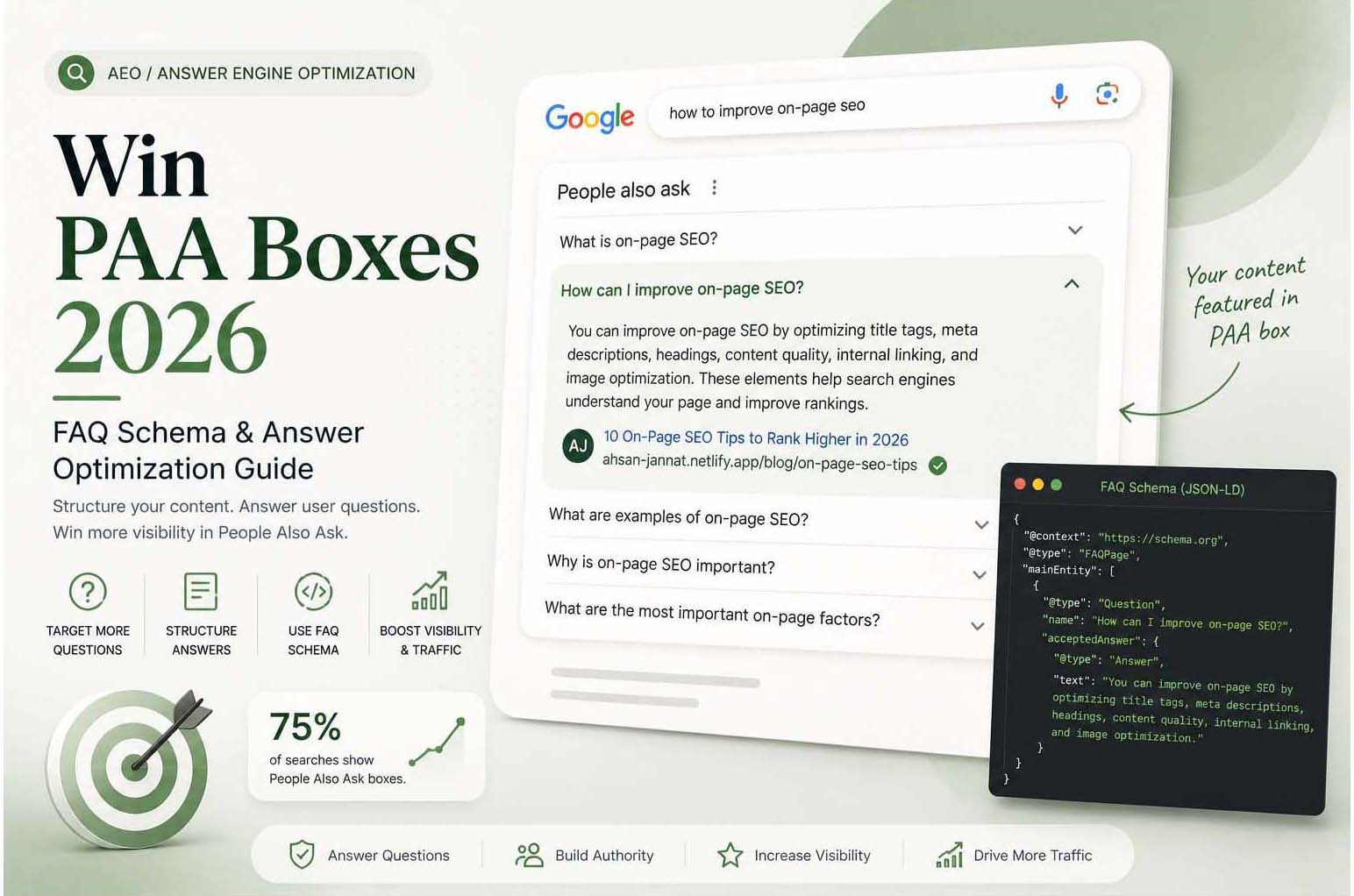
What Are People Also Ask Boxes?
People Also Ask (PAA) boxes are expandable question-and-answer sections that appear within Google search results, typically below the first organic result or featured snippet. When a user clicks to expand a question, Google shows a brief answer pulled from a webpage — and the box expands to show four more related questions.
They're valuable because they provide additional above-the-fold visibility beyond traditional organic rankings — and they appear on the vast majority of searches.
Why PAA Matters for Your Visibility
PAA boxes offer three distinct advantages over standard organic rankings:
- Dual presence — You can appear in both a PAA box and organic results for the same query, effectively doubling your visibility
- Brand trust — Having Google cite your content as the answer to a question establishes instant credibility
- Cascade effect — Expanding a PAA box triggers four more questions, all of which can be from your site
Opportunity: Unlike featured snippets where only one result wins, multiple PAA answers on the same results page can come from the same website. Target a cluster of related questions and you can dominate a topic's entire PAA section.
How Google Selects PAA Answers
Google pulls PAA answers from pages that provide a direct, concise answer to a specific question. The selection factors are similar to featured snippets:
- The answer starts immediately after a heading that mirrors the question
- The answer is between 40–60 words — long enough to be complete, short enough to be scannable
- The answer uses plain, factual language — not promotional or vague
- The source page has relevance and authority for the topic
- FAQPage or Q&A schema is present (not required but strongly helpful)
Content Structure for PAA Success
Research PAA Questions for Your Target Keywords
Search your main keywords and note every PAA question that appears. Also check "People Also Ask" expansions — keep clicking to reveal more. These are your content targets. Tools like AlsoAsked.com visualise the full PAA tree.
Create Dedicated H2/H3 Sections for Each Question
Each target PAA question should have its own heading in your content, written exactly as users ask it. Directly below each heading, write a 40–60 word answer. Then you can expand into more detail.
Add a Standalone FAQ Section
At the bottom of your page or post, add a dedicated FAQ section with 5–8 question-and-answer pairs. Keep each answer tight and factual. This section is the primary target for FAQPage schema markup.
Use Conversational Question Phrasing
Frame headings as natural questions users actually type: "What is...", "How do I...", "Why does...", "When should...". Avoid keyword-stuffed headings — Google wants natural language in 2026.
Implementing FAQ Schema
FAQPage schema tells Google explicitly that your page contains question-and-answer content, making it significantly easier for the algorithm to extract PAA answers. Here's a minimal implementation:
Add FAQPage schema as a JSON-LD script in your page's <head>. For WordPress users, plugins like Rank Math and Yoast SEO can generate this automatically from your FAQ blocks.
| Schema Property | Value | Required? |
|---|---|---|
| @type | FAQPage | Yes |
| mainEntity | Array of Question objects | Yes |
| @type (question) | Question | Yes |
| name | The question text | Yes |
| acceptedAnswer | Answer object with @type: Answer | Yes |
| text (answer) | The answer text | Yes |
Real Optimization Examples
Here's the difference between a PAA-unfriendly and PAA-friendly answer format for the question "What is technical SEO?":
PAA-unfriendly: "Technical SEO is a very important part of your overall digital marketing strategy that many businesses overlook, and it involves many different components that work together to help search engines understand your website better..."
PAA-friendly: "Technical SEO is the process of optimising a website's infrastructure so search engines can crawl, index, and understand it efficiently. It covers site speed, structured data, crawlability, mobile optimisation, and Core Web Vitals — the foundation that all other SEO builds on."
Conclusion
PAA boxes are one of the most accessible SERP features to win — they appear on three-quarters of all searches and can be captured through disciplined content structure and FAQ schema, without requiring high domain authority or extensive link building.
Start by auditing your 10 most important pages. Find the PAA questions that appear for those pages' target keywords. Add dedicated heading-plus-answer sections for each question, implement FAQPage schema, and watch your PAA presence grow within 4–8 weeks.
Need Help with SEO, AEO or GEO?
Let's build a visibility strategy that works across Google, AI answers and generative search.
Start a Free Consultation