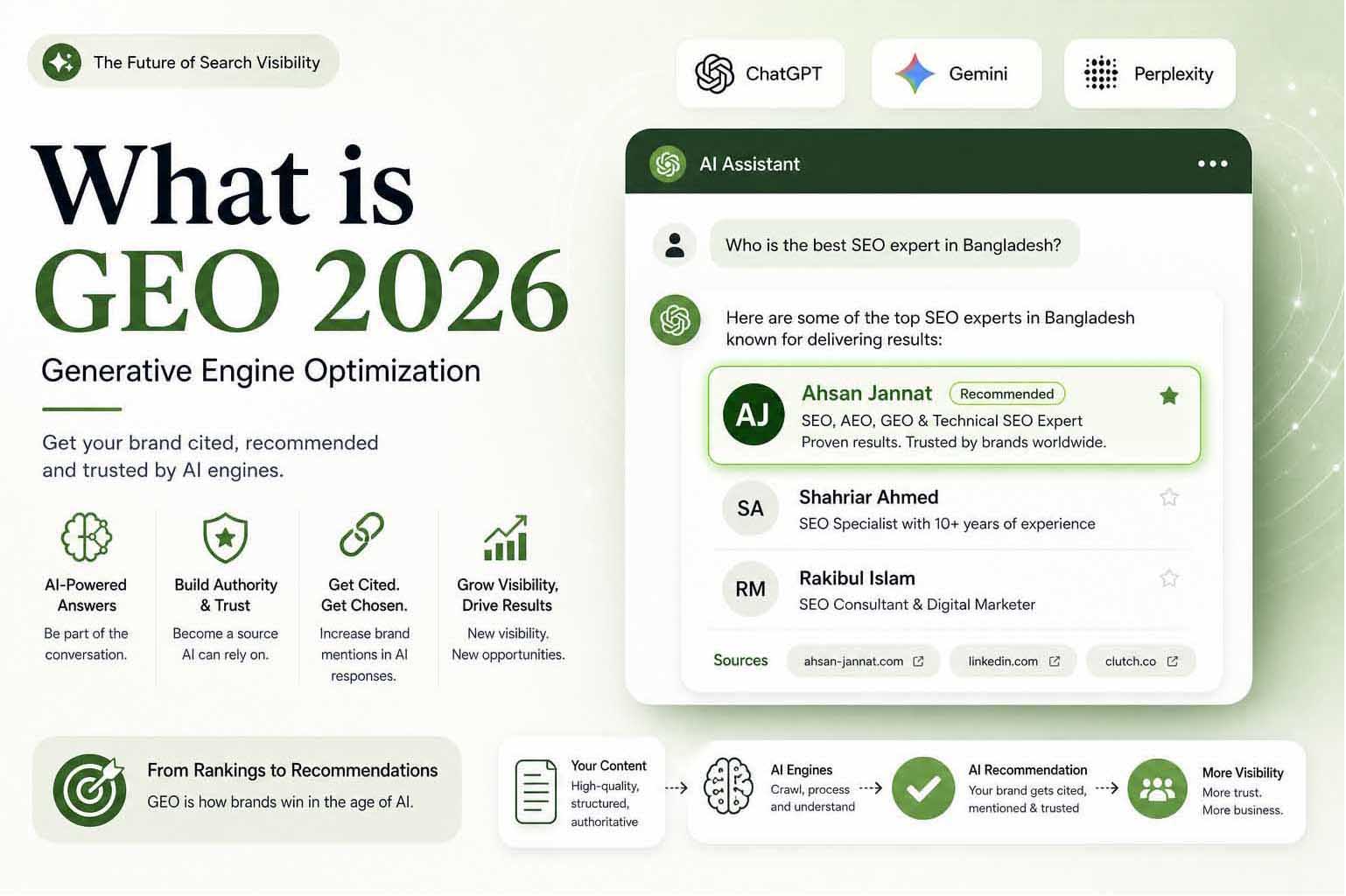
What is Generative Engine Optimization?
Generative Engine Optimization (GEO) is the practice of optimizing your brand's online presence so that large language models (LLMs) — like ChatGPT, Google Gemini, and Perplexity — cite, mention, or recommend your brand when users ask relevant questions.
Unlike traditional SEO which targets search engine rankings, GEO targets the outputs of AI systems that synthesize information from vast training datasets and real-time web access.
Simple definition: If someone asks ChatGPT "What's the best SEO tool for small businesses?" and your brand appears in the answer — that's GEO working. If it doesn't, that's a GEO gap.
Why GEO Matters Right Now
AI assistants are becoming primary discovery channels. A 2024 study found that over 30% of internet users now use AI chatbots as their primary search tool for certain query types — particularly product research, service comparisons, and "best of" questions.
For brands, this creates a new visibility gap. You can rank on page one of Google and still be completely invisible to the growing segment of users who ask ChatGPT instead of searching.
How LLMs Decide What to Cite
LLMs don't "rank" websites the way Google does. Instead, they generate responses based on patterns in their training data and (for models with web access) real-time retrieval. The factors that influence whether your brand appears include:
- Frequency of mentions — How often your brand appears in high-quality sources that LLMs are trained on
- Authority of sources — Being mentioned in Wikipedia, major publications, academic sources, and industry authorities
- Sentiment and context — Being mentioned positively and in relevant contexts to your industry
- Entity clarity — Having a clearly defined entity (what your brand is, does, and stands for) across the web
- Structured data — Schema markup that helps AI systems understand your brand's identity
Core GEO Tactics
Build Your Brand Entity
Create and verify a Google Knowledge Panel, Wikipedia page (if eligible), and Wikidata entry. The more structured your entity data, the better AI systems understand who you are.
Get Cited in Authority Publications
Guest posts, expert quotes, and features in major industry publications put your brand in the training data and retrieval pools that LLMs access. Prioritise publications with high domain authority.
Create "Answer-First" Content
Write content that directly and concisely answers common questions in your niche. LLMs favour sources that provide clean, factual, well-structured answers over long-form promotional content.
Monitor Your AI Presence
Regularly ask ChatGPT, Gemini, and Perplexity questions about your industry. Note whether your brand appears, how it's described, and what competitors are cited instead.
Fix Negative or Inaccurate AI Mentions
If an LLM describes your brand inaccurately, trace the source of the misinformation and correct it at origin — whether that's a Wikipedia entry, an old article, or an inaccurate directory listing.
How to Measure GEO Results
| Metric | How to Track | Target |
|---|---|---|
| Brand mention frequency | Manual AI queries, tools like Profound | Increasing mentions over time |
| Sentiment of mentions | Manual review of AI outputs | Positive or neutral |
| Query coverage | Test 20 core industry queries monthly | Appear in 30%+ of relevant queries |
| Authority citations | Track backlinks from high-DA publications | Consistent growth |
Conclusion
GEO is not replacing SEO — it's the next layer on top of it. As AI assistants handle more discovery queries, the brands with strong entity presence, authority mentions, and clear digital identity will win the AI visibility game.
Start by auditing your brand's current presence in ChatGPT and Gemini. The gaps you find are your GEO roadmap.
Need Help with SEO, AEO or GEO?
Let's build a visibility strategy that works across Google, AI answers and generative search.
Start a Free Consultation