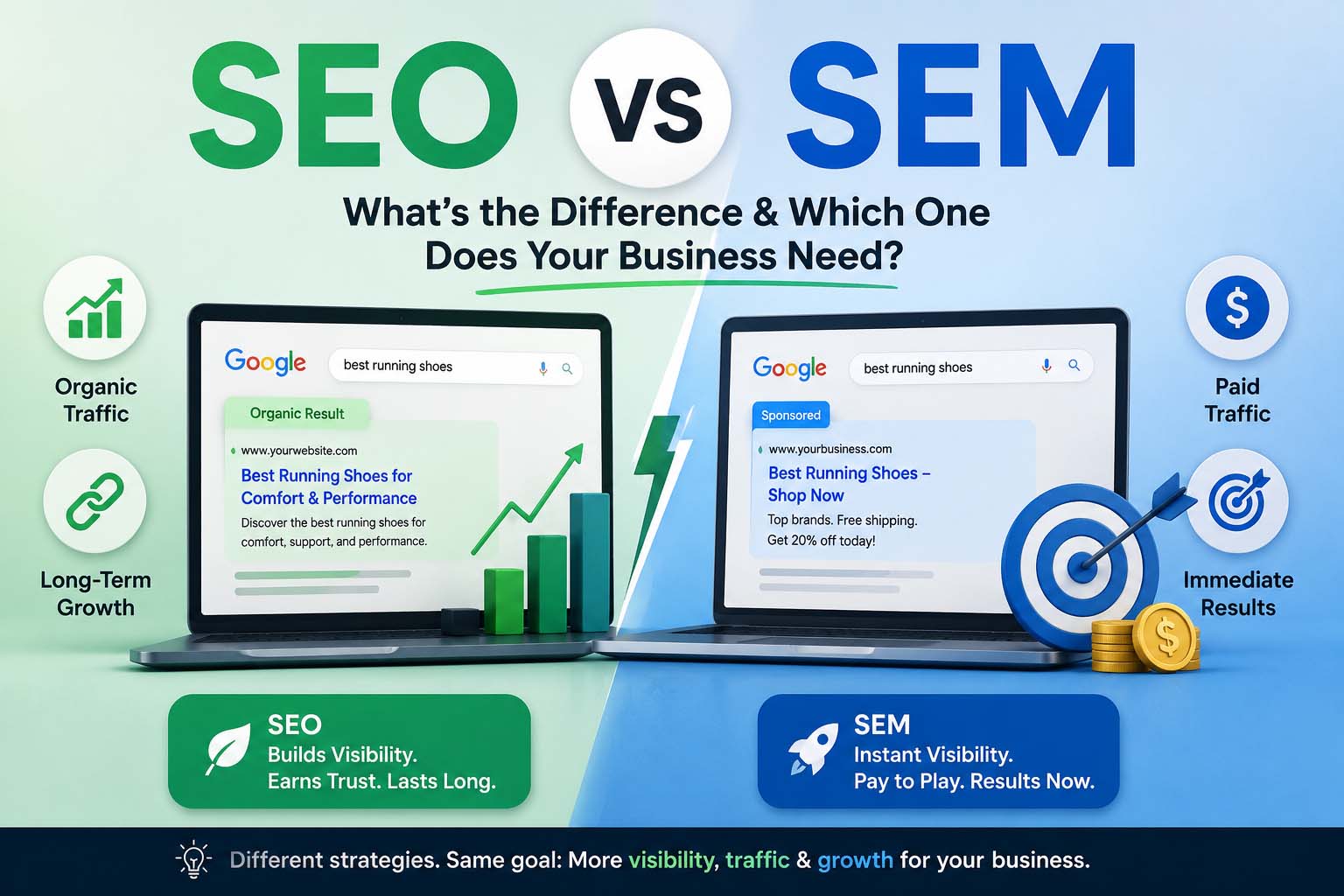
If you've spent any time researching digital marketing, you've seen SEO and SEM mentioned together — sometimes interchangeably, often confusingly. They're related but fundamentally different in how they work, what they cost, and when they deliver results.
Understanding the distinction is critical because the wrong choice costs real money. Investing heavily in Google Ads when you actually need long-term organic authority is expensive. Starting with SEO when you need leads this week is slow. This guide cuts through the confusion so you can make the right call for your business.
One-line summary: SEO = earning traffic for free through rankings. SEM = paying for visibility in search results. Both live in search engines. Both drive traffic. Everything else is details.
Defining SEO and SEM
What is SEO?
SEO (Search Engine Optimization) is the practice of optimizing your website so it earns higher positions in organic (unpaid) search results. When someone searches "best SEO consultant in Dhaka" and clicks a result — not an ad — that's organic traffic driven by SEO.
SEO encompasses on-page optimization (content, titles, schema), technical SEO (site speed, crawlability, indexation), and off-page SEO (backlinks, brand authority). Results build slowly but compound — a page that ranks well today can generate traffic for years with minimal ongoing cost.
What is SEM?
SEM (Search Engine Marketing) is the umbrella term for using search engines to drive traffic — including both organic SEO and paid advertising. However, in common usage, SEM has come to mean specifically paid search advertising — primarily Google Ads (formerly Google AdWords) and Microsoft Advertising (Bing Ads).
With SEM/PPC, you bid on keywords and pay each time someone clicks your ad. Your ad appears above organic results with a small "Sponsored" label. Results are immediate — your ad can appear within hours of launching. But the moment you stop paying, the traffic stops.
Key Differences: Side by Side
| Factor | SEO | SEM (PPC) |
|---|---|---|
| Cost model | Time and effort (no per-click cost) | Pay per click (ongoing spend) |
| Time to results | 3–6 months minimum | Hours to days |
| Traffic durability | Continues even without active work | Stops immediately when budget runs out |
| Click-through rate | Higher organic trust (users prefer organic) | Lower (users know it's an ad) |
| Targeting precision | Keyword and intent-based | Keyword + demographic + location + device + time |
| Scalability | Grows through content creation | Grows by increasing budget |
| Competition | Domain authority and backlinks | Bid price and Quality Score |
| AI search visibility | Strong (LLMs index organic content) | None (AI doesn't cite paid ads) |
SEO: Pros and Cons
Advantages of SEO
- Zero cost per click — once you rank, traffic is free regardless of volume
- Compounding returns — rankings and traffic grow over time with consistent effort
- Higher trust and credibility — organic results are perceived as more trustworthy than ads
- AI search visibility — well-optimized pages get cited in ChatGPT, Gemini, and AI Overviews
- Broader reach — you can rank for thousands of related keywords, not just the ones you bid on
Disadvantages of SEO
- Slow to start — 3–6 months before meaningful results for most sites
- Algorithm dependence — Google updates can impact rankings without warning
- Requires consistent effort — content creation, link building, and technical maintenance
- Harder to measure exact ROI — attribution is less direct than paid campaigns
SEM/PPC: Pros and Cons
Advantages of SEM
- Instant visibility — your ad can appear on page one within hours
- Precise targeting — target by keyword, location, device, time, demographics, and intent
- Full budget control — set daily limits; scale up or pause instantly
- Rich conversion data — know exactly which keywords drive sales and at what cost
- Works for any budget — you can start with $5/day and scale up
Disadvantages of SEM
- Traffic stops when budget stops — no residual value once you pause campaigns
- Increasingly expensive — CPC costs have risen significantly in competitive niches
- Ad blindness — many users scroll past ads, especially for informational queries
- No AI search benefit — paid ads are not indexed by AI systems like ChatGPT
- Requires ongoing management — poorly managed campaigns waste budget quickly
When to Choose SEO
SEO is the right primary investment when:
You're building long-term brand authority
If your goal is to be the recognized expert in your niche — someone Google and AI systems consistently recommend — SEO is non-negotiable. PPC can't build the entity authority that GEO and AEO require.
Your budget is limited but you have time
SEO trades time for money. If you can invest 6–12 months of consistent effort — creating content, earning links, fixing technical issues — you can compete with businesses spending thousands on ads monthly.
You want AI search visibility (GEO)
AI tools like ChatGPT and Perplexity cite organic web content — not paid ads. If appearing in AI-generated answers is part of your strategy (and it should be in 2026), you need strong organic SEO as the foundation.
You're targeting informational and research queries
For "how to", "what is", "best way to" style queries, users heavily prefer organic results. Spending money on PPC for these queries delivers poor ROI. SEO-optimised content is far more effective.
When to Choose SEM
SEM/PPC is the right primary investment when:
- You need leads or sales immediately — a product launch, seasonal campaign, or new business
- Your organic competition is extremely fierce and would take years to overcome
- You're testing which keywords and offers convert before committing to SEO content creation
- You have high-value transactional keywords ("SEO consultant for hire") where even one click can cover months of ad spend
- You're running a time-limited promotion or event
Using SEO and SEM Together — The Smart Approach
The most effective digital marketing strategies use SEO and SEM together, with each amplifying the other:
"Run PPC to generate immediate revenue and gather conversion data. Use that data to guide your SEO content strategy. As organic rankings grow, reduce ad spend on keywords where you rank organically."
Specifically, the combined approach looks like this:
- Month 1–3: Run targeted PPC campaigns on your highest-value keywords to generate leads while SEO gains traction
- Month 1–6: Build SEO foundations — technical fixes, keyword research, core content creation
- Month 4–9: As organic rankings improve for specific keywords, reduce PPC spend on those terms and reinvest in new PPC targets
- Month 9+: Organic traffic handles most informational and branded traffic. PPC focuses on high-intent transactional keywords where immediate conversion matters
Cost Comparison: What to Expect
| Investment Type | Monthly Cost Range | Time to Results | Traffic Lifespan |
|---|---|---|---|
| DIY SEO | $0–$200 (tools only) | 6–12 months | Years (compounds) |
| Outsourced SEO | $300–$2,000+/month | 3–6 months | Years (compounds) |
| Google Ads (small business) | $300–$1,500/month | Days | Duration of spend only |
| Google Ads (competitive niche) | $2,000–$10,000+/month | Days | Duration of spend only |
Which Should You Choose?
For most businesses — especially service businesses, consultants, and agencies — SEO should be the primary long-term investment. It builds compounding value, establishes authority, and increasingly drives AI search visibility that paid ads simply cannot reach.
If you need immediate results while SEO builds, run focused PPC campaigns on your highest-intent, highest-value keywords. Use the conversion data to sharpen your SEO strategy.
The answer is rarely SEO or SEM. It's usually SEO first, SEM when strategically useful, and both working together for maximum impact.
Not sure which approach is right for your specific situation? Book a free consultation and I'll give you an honest assessment.
Need Help with SEO, AEO or GEO?
Let's build a visibility strategy that works across Google, AI answers and generative search.
Start a Free Consultation