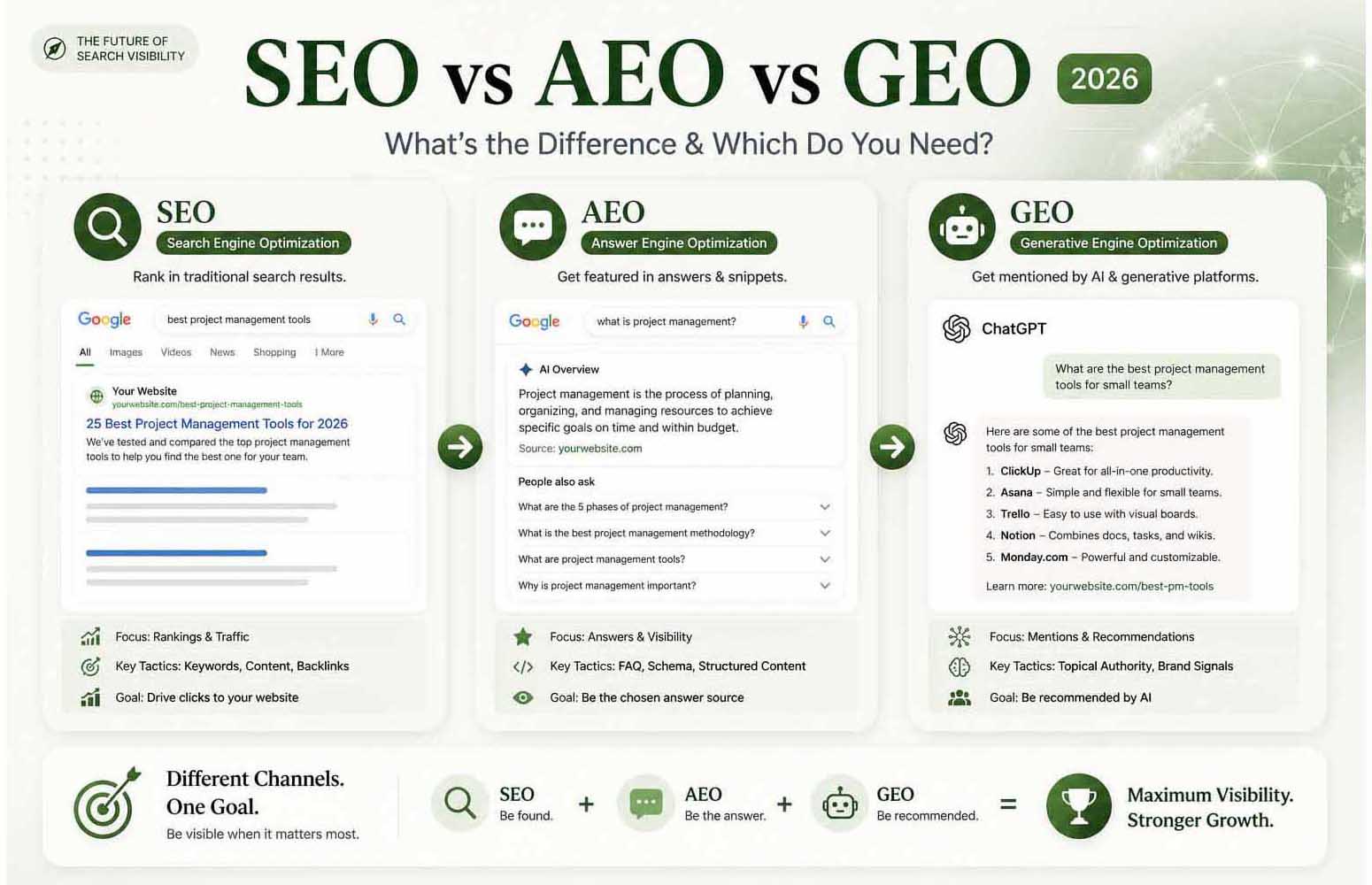
What is the Search Stack in 2026?
Search has changed more in the last two years than in the previous decade. When someone wants to find a product, answer a question, or discover a service, they no longer rely only on Google's ten blue links. They ask ChatGPT. They use Perplexity. They speak to Siri or Alexa. Google's own AI Overviews now answers questions before the user even sees a website.
For businesses and content creators, this means your digital visibility strategy must go beyond traditional SEO. It must account for three distinct layers: Search Engine Optimization (SEO), Answer Engine Optimization (AEO), and Generative Engine Optimization (GEO).
Quick takeaway: SEO gets you ranked on Google. AEO gets you into AI-powered answer boxes. GEO gets you cited by ChatGPT, Gemini, and Perplexity. You likely need all three.
What is SEO (Search Engine Optimization)?
SEO is the practice of optimizing your website so it ranks higher on search engines like Google and Bing for relevant keywords. It's been the backbone of digital marketing for over 25 years and remains essential — but it's no longer sufficient on its own.
Core SEO components
- On-Page SEO — Optimizing titles, meta descriptions, headings, content quality and keyword placement
- Technical SEO — Site speed, Core Web Vitals, crawlability, indexation, and structured data
- Off-Page SEO — Link building, digital PR, brand mentions and authority signals
- Local SEO — Google Business Profile, citations, and Map Pack rankings
What is AEO (Answer Engine Optimization)?
AEO is the process of structuring your content so it appears in direct answer formats — featured snippets, People Also Ask (PAA) boxes, voice search results, and Google's AI Overviews. Instead of ranking for a keyword, you're answering a specific question better than anyone else.
What AEO targets
- Featured Snippets — The paragraph, list, or table Google shows at position zero
- People Also Ask (PAA) — The expanding question boxes that appear mid-results
- Voice Search — Smart speaker and mobile voice assistant answers
- AI Overviews — Google's generative AI summaries shown above organic results
"If SEO is about ranking, AEO is about answering — and the brands that answer best get the attention before the user even scrolls."
What is GEO (Generative Engine Optimization)?
GEO is the newest layer. It refers to optimizing your brand's presence so that large language models (LLMs) like ChatGPT, Google Gemini, and Perplexity cite or recommend your brand when users ask relevant questions.
Unlike SEO and AEO which operate within search engines, GEO operates within AI models that have been trained on massive datasets. These models don't crawl your website in real time — they reflect the information they were trained on and the sources they can access.
GEO strategies include
- Building brand entity presence (Wikipedia, Wikidata, structured knowledge)
- Getting cited in high-authority publications that LLMs are trained on
- Creating authoritative content that answers the exact questions users ask AI tools
- Monitoring your brand's presence in ChatGPT, Gemini and Perplexity responses
Side-by-Side Comparison
| Dimension | SEO | AEO | GEO |
|---|---|---|---|
| Target Channel | Google/Bing rankings | Answer boxes, voice | ChatGPT, Gemini, Perplexity |
| Goal | Page 1 rankings | Zero-click answers | LLM citations |
| Key Tactic | Keywords + links | FAQ + structured data | Entity building + authority |
| Speed of Results | 3–6 months | 4–8 weeks | Ongoing |
| Maturity | 25+ years | 5–7 years | Emerging (2023+) |
Which One Do You Need?
Start with SEO
If you don't have SEO in place, start here. It's the foundation. Without solid on-page, technical and off-page SEO, the other layers are harder to build.
Layer in AEO
Once you rank for target keywords, restructure content to capture featured snippets and PAA boxes. Add FAQ schema. This is where existing traffic gets multiplied.
Build for GEO
As your brand authority grows, focus on being cited by AI systems. Build your entity, get coverage in authoritative publications, and create content that AI models reference.
Most established businesses need all three. But if you're starting from zero, prioritise SEO → AEO → GEO in that sequence.
Conclusion
SEO, AEO and GEO are not competing strategies — they're complementary layers of a complete search visibility system. Each one targets a different moment in the user's journey: the scroll, the quick answer, and the AI conversation.
The businesses that will dominate search in 2026 and beyond are those that build visibility across all three channels. If you're only doing SEO, you're leaving significant traffic on the table.
Need Help with SEO, AEO or GEO?
Let's build a visibility strategy that works across Google, AI answers and generative search.
Start a Free Consultation