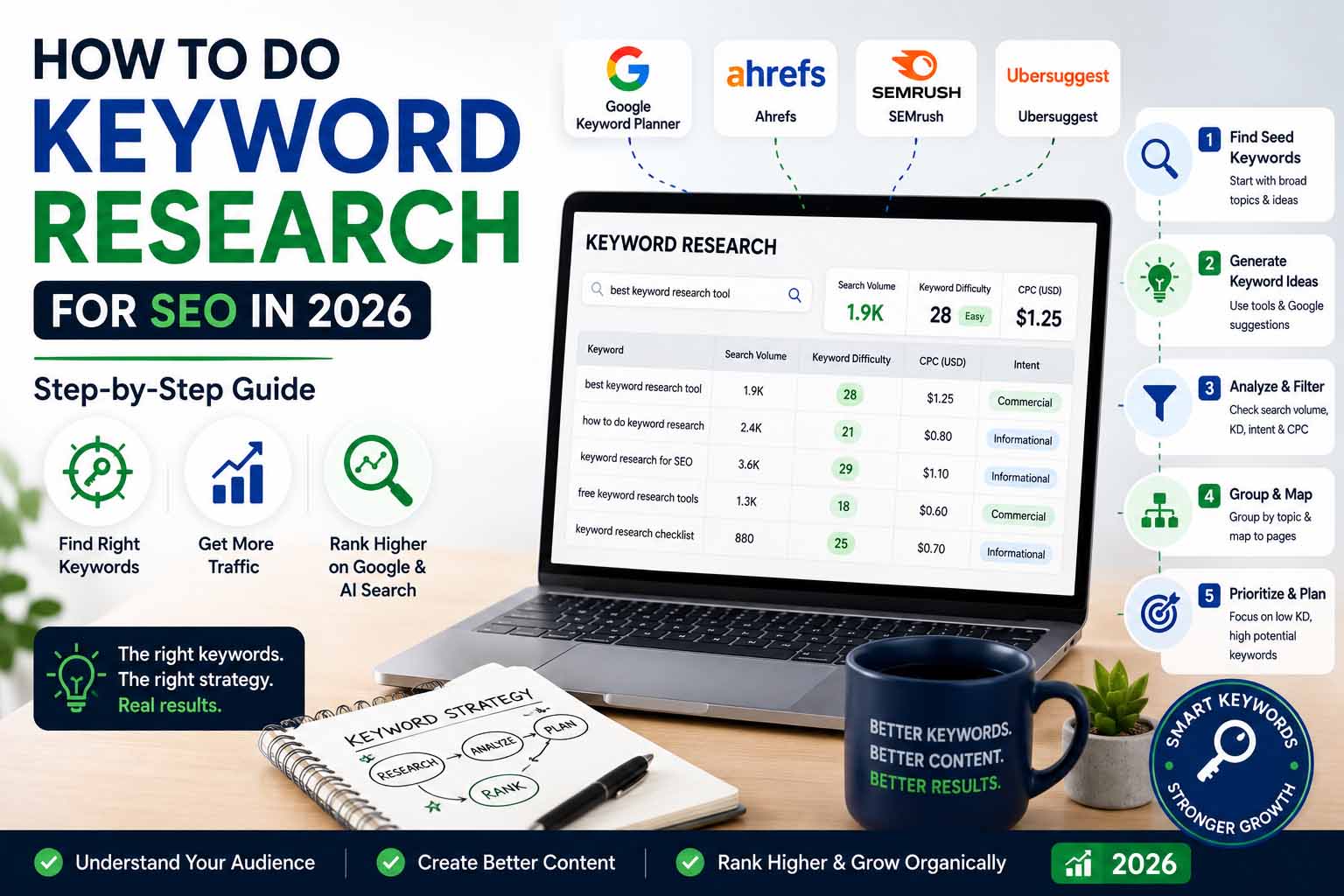
Keyword research is the foundation of every successful SEO strategy. It tells you what your audience is searching for, how competitive those searches are, and where your content has the best chance of ranking. Done correctly, it drives consistent, compounding organic traffic. Done wrong — or skipped entirely — even great content sits invisible on page 10.
In 2026, keyword research has evolved. You're no longer just optimising for Google's blue links — you need to think about AI Overviews, ChatGPT citations, and voice search answers. This guide covers the complete process from scratch.
What you'll learn: How to find keywords with real traffic potential, how to evaluate competition honestly, how to map keywords to content, and how to optimise for AI search alongside traditional Google rankings.
What is Keyword Research and Why It Matters
Keyword research is the process of discovering and analysing the words and phrases people type into search engines when looking for information, products, or services. It bridges the gap between what you write about and what your audience actually searches for.
Without keyword research, you're guessing. With it, you're building a content strategy backed by real data on search demand, competition, and user intent.
Keyword research matters because it helps you:
- Understand exactly what your audience wants to know
- Create content that matches search intent — the real reason behind every query
- Prioritise topics where you can realistically compete and win
- Build topical authority that signals expertise to Google and AI systems
- Identify conversion-driving keywords that attract buyers, not just readers
Types of Keywords You Need to Know
By Length
| Type | Example | Volume | Competition | Intent Clarity |
|---|---|---|---|---|
| Short-tail (head terms) | "SEO" | Very high | Extreme | Unclear |
| Mid-tail | "keyword research tools" | Medium | High | Moderate |
| Long-tail | "how to do keyword research for a new blog" | Low | Low | Very clear |
New site strategy: Start with long-tail keywords. They're easier to rank for, attract highly specific audiences, and build your domain authority while you work toward more competitive head terms.
By Intent
Informational
"What is on-page SEO?" — The user wants to learn. These keywords build authority and attract top-of-funnel visitors. Great for blog posts and guides.
Navigational
"Ahrefs login" — The user wants to reach a specific site or page. Only relevant if your brand is the destination.
Commercial Investigation
"Best SEO tools 2026" — The user is comparing options before buying. High conversion potential — great for listicles and comparison posts.
Transactional
"hire SEO consultant Bangladesh" — The user is ready to act. Highest commercial value — target these on service and contact pages.
Key Metrics to Evaluate Keywords
Every keyword should be evaluated across four dimensions before you decide to target it:
| Metric | What It Measures | Where to Check | Target for New Sites |
|---|---|---|---|
| Search Volume | Monthly searches | Ahrefs, SEMrush, GKP | 100–3,000/month |
| Keyword Difficulty (KD) | Competition level (0–100) | Ahrefs, SEMrush | Under 30 |
| Cost Per Click (CPC) | Commercial value proxy | Google Keyword Planner | Higher = more valuable |
| Search Intent | Why the user is searching | Manual SERP inspection | Matches your content type |
Never chase volume alone. A keyword with 50,000 monthly searches and KD 85 is worthless for a new domain. A keyword with 800 monthly searches, KD 18, and commercial intent can generate real leads within 90 days.
Best Keyword Research Tools in 2026
Free Tools
- Google Keyword Planner — Direct from Google's ad platform. Shows volume ranges and competition. Best starting point.
- Google Search Console — Shows what keywords your site already ranks for. Gold mine for finding quick wins.
- Google Suggest / Autocomplete — Type your seed keyword and note what Google suggests. Real user queries.
- AnswerThePublic — Visualises questions people ask around a topic. Excellent for finding long-tail and PAA keywords.
- Google Trends — Spot seasonal patterns and rising trends before competitors do.
Paid Tools
- Ahrefs — Most accurate keyword data, best for competitor analysis and finding keyword gaps.
- SEMrush — Comprehensive suite with keyword magic tool, position tracking, and intent classification.
- Ubersuggest — Affordable entry-level option with solid keyword data and limited free searches.
Step-by-Step Keyword Research Process
Define Your Topic Clusters
Start with 5–10 broad topics that represent your business. For an SEO consultant: "SEO", "content marketing", "link building", "technical SEO", "local SEO". These become your pillar topics — each one anchors a cluster of related blog posts.
Generate Seed Keywords
For each pillar topic, brainstorm 10–20 related search phrases. Think about what your ideal client types when they have a problem you solve. Write down every variation — include "how to", "best", "vs", "guide", "checklist" modifiers.
Expand Using Tools
Plug your seed keywords into Ahrefs or SEMrush Keyword Magic Tool. Filter for: KD under 30 (for new sites), monthly volume over 100, and informational or commercial intent. Export 50–100 candidates per topic cluster.
Spy on Competitors
Enter your top 3 competitor domains into Ahrefs Site Explorer → Organic Keywords. Look at their highest-traffic pages. Find keywords they rank for that you don't — these gaps represent immediate opportunities.
Inspect the SERP Manually
Search each target keyword in Google. Study what type of content ranks: is it a blog post, video, tool, or product page? If the top 10 results are all from major brands (Forbes, HubSpot, Moz), it will be very hard to compete. If you see niche blogs ranking, you have a real shot.
Prioritise by Opportunity Score
Score each keyword: Volume (1–3) + Low KD (1–3) + Business Relevance (1–3) + Intent Match (1–3) = Priority score out of 12. Build your content calendar starting with the highest-scoring keywords.
Map Keywords to Pages
Each page should target ONE primary keyword and 3–5 related secondary keywords. Never target the same keyword on two different pages — this causes keyword cannibalization, splitting your ranking signals and hurting both pages.
Keyword Research for AI Search in 2026
Traditional keyword research targets Google's blue links. But in 2026, a growing share of searches are answered directly by AI — Google AI Overviews, ChatGPT, Perplexity, and Gemini. Your keyword strategy needs to account for both.
"The keywords that earn AI citations are conversational, question-based, and answer-ready — not the head terms that dominated SEO a decade ago."
For AI search visibility, prioritise:
- Question-format keywords — "What is...", "How do I...", "Why does...", "Which is better..."
- Comparative keywords — "SEO vs SEM", "Ahrefs vs SEMrush", "on-page vs off-page SEO"
- Definition keywords — "What is keyword difficulty", "What is domain authority"
- Step-by-step process keywords — "How to do keyword research step by step"
Then structure your content with a direct answer in the first 50 words, FAQ sections with schema markup, and clear H2/H3 headings that mirror the exact questions. This is the format AI systems pull from to generate answers.
7 Common Keyword Research Mistakes to Avoid
- Targeting only high-volume keywords without checking competition — you'll never rank
- Ignoring search intent — writing a blog post for a keyword that needs a product page
- Keyword cannibalization — two pages competing for the same keyword splits ranking signals
- Skipping SERP analysis — assuming you can rank without checking who you're competing against
- Focusing only on Google — ignoring AI search platforms where your audience increasingly asks questions
- Not updating keyword research — search trends shift; review your strategy quarterly
- Overusing keywords — keyword stuffing is penalized; write naturally and let semantic relevance do the work
Conclusion
Keyword research in 2026 is about finding the intersection of what your audience searches for, what you can realistically rank for, and what your business actually needs. Volume matters — but intent, competition, and strategic fit matter more.
Start with your topic clusters, expand with tools, validate with SERP analysis, and build a content calendar that systematically covers your niche. Do this consistently and your organic traffic compounds month over month.
Need help building a keyword strategy for your business? Get in touch — this is exactly what I do.
Need Help with SEO, AEO or GEO?
Let's build a visibility strategy that works across Google, AI answers and generative search.
Start a Free Consultation