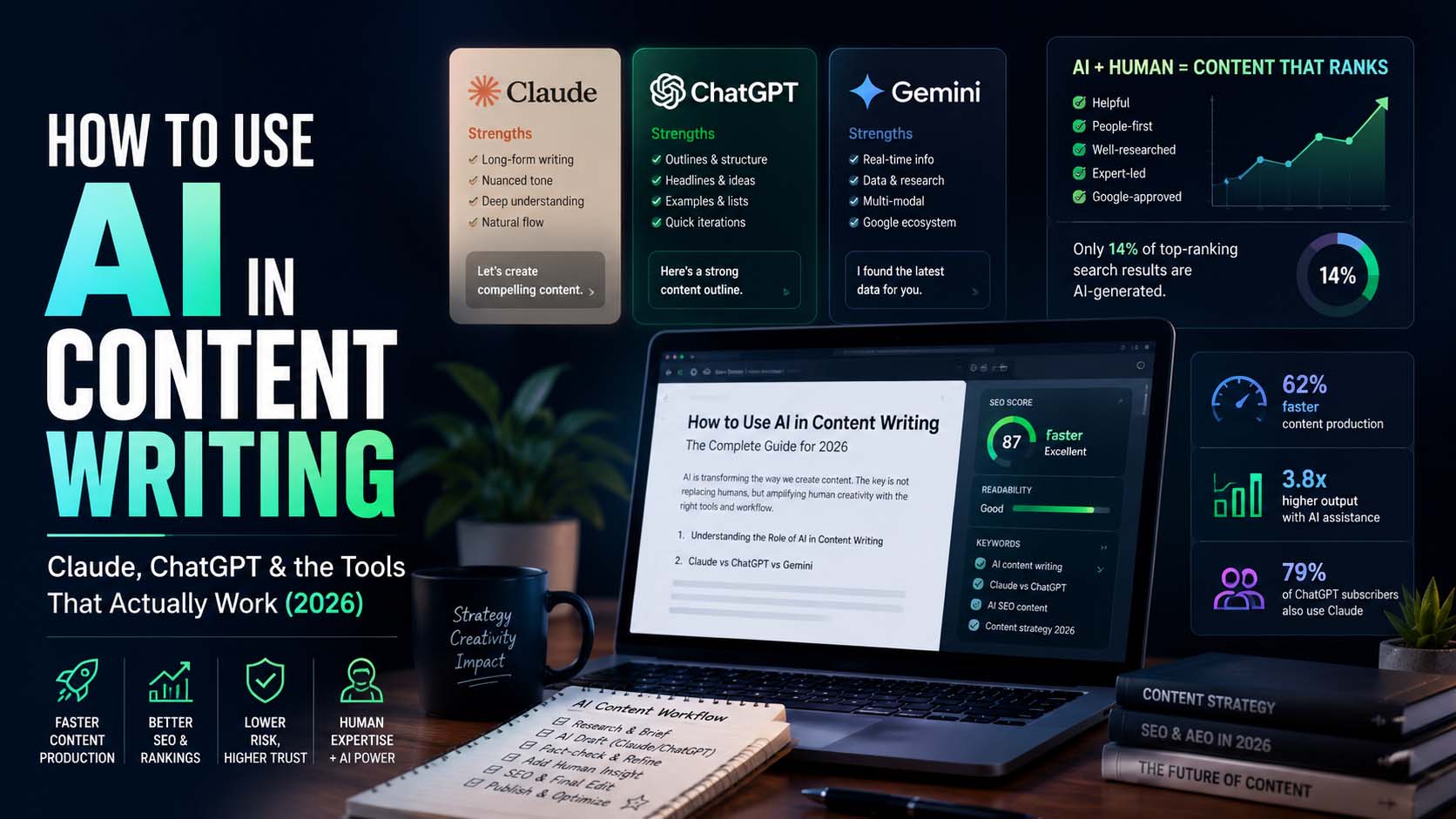
Something shifted in content writing in 2026. Not gradually — dramatically. The question is no longer "should I use AI?" but "which AI, how much, and for what?" And buried inside that question is a more uncomfortable one: is the content you are creating with AI actually helping your brand — or quietly eroding it?
This post cuts through the hype with real 2026 data, an honest comparison of the leading tools including Claude, and a practical workflow that works for SEO without triggering Google's spam filters.
What this post covers: Real market data on AI content adoption, an honest head-to-head of Claude vs ChatGPT vs Gemini for writing, Google's actual position on AI content, and a step-by-step workflow used by professional content teams.
The State of AI in Content Writing (2026 Data)
The numbers don't lie. AI has moved from experimental to essential in content workflows at a pace that has surprised even the most optimistic forecasters.
- Businesses using AI report 62% faster content production and 3.8x higher output compared to fully manual workflows
- Content marketers using AI for editing has doubled in one year — 19% in 2025 to 38% in 2026
- AI-assisted blog writing increases organic traffic by 120% within 6 months when paired with proper SEO strategy
- Marketers using AI-generated content experience a 36% higher conversion rate on landing pages
- AI copywriting tools improve ad click-through rates by 38% while reducing cost-per-click by 32%
- The global generative AI market is projected to reach $91.57 billion in 2026 — up from $63 billion in 2025
- 92% of Fortune 500 companies now use ChatGPT; 79% of developers and 71% of marketers use it professionally
The darker side: 53% of content marketers struggle to make their content stand out in an AI-saturated market. 52% believe AI has made content so easy to create that it has become less effective overall. The barrier to production has collapsed — which means the bar for quality has risen sharply.
Claude: Game-Changer or Risk?
Let's address this directly. Claude, developed by Anthropic, has risen from relative obscurity to become the second most trusted AI tool for content marketing in 2026, with a 55% trust rating among content marketers — behind ChatGPT (80%) but ahead of Gemini (44%) and Perplexity (38%).
Most remarkably, Claude jumped from #5 to #2 in global AI platform rankings between October 2025 and April 2026 — a three-position leap in six months. That kind of rise signals genuine product quality, not marketing spend. Anthropic recently signed an agreement with SpaceX to expand Claude's computing capacity, as demand continues to accelerate — a strong signal of where the market is heading.
Where Claude is a Game-Changer
Long-Form Writing Quality
Claude consistently produces long-form content with a natural, non-robotic tone. In head-to-head testing, Claude avoids the generic AI opener trap. While competitors begin with "In today's competitive landscape...", Claude creates a direct, compelling opening that hooks the reader. Independent research confirms: "Claude distinguishes itself with a direct, compelling opening that avoids AI clichés." This matters enormously for time-on-page and bounce rates — both indirect ranking signals.
Nuanced Writing on Complex Topics
Claude handles complex, nuanced topics — legal, medical, technical, strategic — with more caution and accuracy than most competitors. It asks clarifying questions rather than guessing, producing content that requires less fact-checking and correction time.
Honest About Limitations
Claude explicitly flags when it is uncertain, when information may be outdated, or when a claim needs verification. For SEO content where accuracy directly affects E-E-A-T scores, this is a significant advantage over tools that confidently hallucinate statistics.
Large Context Window
Claude can process an entire content brief, brand guidelines, previous articles, and competitor examples simultaneously — producing output that is far more consistent with your brand voice than tools with shorter memory.
Where Claude is a Risk
Real-Time Data Limitations
Claude has a training knowledge cutoff. For content requiring current statistics, recent events, or live market data, Claude needs web search tools or manually researched data. Publishing Claude's default statistics without verification is a credibility risk. (All statistics in this article were independently verified from 2026 sources.)
Conservative on Controversial Takes
Claude's safety-first design means it can be overly cautious on topics requiring bold, decisive opinions. For content marketing that needs a strong point of view — comparison pieces, industry critiques, opinion content — Claude sometimes produces content that hedges too much.
Less Structured Formatting by Default
While Claude writes beautifully in prose, it requires explicit prompting to consistently produce SEO-friendly formats with proper heading hierarchies, bullet structures, and schema-ready FAQ sections. ChatGPT applies these structures more automatically.
Claude vs ChatGPT vs Gemini: Real Comparison
| Task | Claude | ChatGPT | Gemini |
|---|---|---|---|
| Long-form blog writing | 🏆 Best — natural tone, no clichés | Strong — structured, example-rich | Good — tends toward generic |
| SEO content structure | Good — needs explicit prompting | 🏆 Best — auto-applies formats | Moderate |
| Fact accuracy | 🏆 Best — flags uncertainty | Good — occasionally hallucinates | Good — Google data advantage |
| Real-time information | Limited (web search helps) | Limited (browse mode helps) | 🏆 Best — Google integration |
| Brand voice consistency | 🏆 Best — large context window | Good | Moderate |
| Headline writing | Good | 🏆 Best — highest CTR-optimized | Moderate |
| Technical and complex topics | 🏆 Best — nuanced and cautious | Good | Good |
| Social media copy | Good | 🏆 Best — punchy and platform-aware | Good |
| Marketer trust rate (2026) | 55% — ranked #2 | 80% — ranked #1 | 44% — ranked #3 |
The professional answer: Don't pick one. Data shows 79% of ChatGPT subscribers also pay for Claude. The ideal workflow uses Claude for drafting and nuanced writing, ChatGPT for headlines and structured outlines, and Gemini for real-time data research. They complement each other perfectly.
What Google Actually Says About AI Content
Google's official position is clear: it does not penalize AI-generated content by default. Its systems reward high-quality, helpful content regardless of whether a human or AI wrote it.
What Google does penalize is "scaled content abuse" — mass-producing pages with no real value to users purely to game rankings. This was always spam. AI just made it faster to produce at scale.
Google's E-E-A-T framework (Experience, Expertise, Authoritativeness, Trust) is the lens through which all content is evaluated. An AI can help you draft — but it cannot provide your genuine industry experience, your original research, or your professional credibility. Those must come from the human author.
The Professional AI Content Workflow (That Actually Works)
Research First — Always Human
Before touching any AI tool, research your topic manually. Find real data, identify gaps in existing content, note what competitors missed, and define your unique angle. This research phase is what separates content that ranks from content that sits on page 10. AI cannot replicate your research process or your source judgment.
Build a Detailed Brief
Write a content brief including: target keyword and intent, key points to cover, data points and sources you found, your specific angle, brand voice notes, and competitor gaps to fill. The more detailed your brief, the better your AI output. Garbage in, garbage out applies to AI more than anything.
Use Claude for the First Draft
Feed your brief to Claude with explicit instructions on format — H2/H3 structure, FAQ section, word count, tone. Claude's strength is producing a readable, non-robotic draft that covers the topic comprehensively. Write the headline and opening hook yourself for maximum originality and impact.
Fact-Check Every Single Claim
This is non-negotiable. Verify every statistic, every claim, every named source independently. AI hallucination is real — even the best models occasionally cite non-existent studies or misattribute statistics. One wrong fact damages your credibility far more than the time saved by skipping the check.
Add Your Human Layer
This is where content goes from "AI-written" to "AI-assisted by an expert." Add your personal experience, examples from your client work, your genuine opinion, original observations, and your professional take on where the field is heading. This layer is irreplaceable and is what E-E-A-T actually rewards.
Optimise for SEO and AI Search
Apply your on-page SEO checklist: title tag, meta description, heading structure, internal links, schema markup. Add an FAQ section targeting PAA queries — the bridge between traditional SEO and AEO/GEO visibility. FAQ schema signals structured Q&A content to both Google and LLMs.
Edit for Voice and Flow
Read your finished piece out loud. Does it sound like you — or a committee of robots? Edit ruthlessly. Cut AI filler phrases ("It is worth noting that...", "In conclusion..."). Replace generic transitions with specific observations. Make every paragraph earn its place.
AI Content and SEO: What the 2026 Data Shows
- AI Overviews appear on 48% of Google queries — up from 31% in early 2025, reaching 2 billion monthly users
- AI search visitors convert at 4–5x the rate of traditional organic traffic
- Content with statistics sees 28–40% higher visibility in AI search results — original data is among the strongest AI citation signals
- 44.2% of LLM citations come from the first 30% of content — your opening paragraphs are disproportionately important
- Earned media increases AI citations by 325% compared to publishing only on your own site
- Only 54% of organisations optimise for AI-powered discovery — nearly half your competitors are missing this entirely
- Sites with 32,000+ referring domains are 3.5x more likely to be cited by ChatGPT
The GEO opportunity: 46% of businesses are NOT optimising for AI discovery. Being an early mover in GEO and AEO is worth more than years of traditional link building right now. The window is open — but it won't stay open forever.
5 AI Content Mistakes That Kill Your Rankings
- Publishing without editing. Unedited AI output is detectable — by Google's algorithms, by savvy readers, and by competitors who will report it. Every AI draft needs a human edit pass before going live.
- Skipping fact verification. AI tools hallucinate. Statistics get misattributed. Studies get invented. One falsified data point can destroy years of trust-building with your audience. Verify every claim independently.
- No original perspective. If your AI-assisted content says exactly what every other AI article says, you have created noise, not value. Your unique expertise, original examples, and genuine opinions are what make content worth ranking.
- Ignoring E-E-A-T signals. AI content without a credible author bio, cited sources, and demonstrated expertise reads like filler to both Google and readers. Every piece needs a named expert author with verifiable credentials.
- Keyword stuffing via AI prompts. Asking AI to "include the keyword every 100 words" produces unnatural, over-optimised content. Prompt AI to write naturally around your topic — SEO optimisation happens in the editing phase, not the generation phase.
Where AI Content Is Heading
- The market is diversifying, not centralising. ChatGPT's share fell from 86% to 64% in 12 months. Claude jumped from #5 to #2. DeepSeek entered the top 5 from nowhere. The "one AI to rule them all" era is over — multi-tool workflows are now standard for professional teams
- AI content roles are the fastest-growing job category. AI content creators are the second fastest-growing role in marketing with a 134.5% increase in demand. Humans who can direct, edit and optimise AI output are more valuable than ever
- Authenticity becomes the differentiator. As AI floods the internet with generic content, brands that win add original research, genuine data, human experience, and brand personality. AI handles production — humans handle meaning
- GEO overtakes traditional SEO as the primary traffic driver. With AI Overviews on 48% of queries and growing, optimising for AI citation will likely matter as much as traditional Google rankings by late 2027
- Labelling AI content becomes standard practice. Transparency about AI assistance in content creation is increasingly expected by both regulators and audiences
Verdict: Should You Use AI for Content?
Yes. Unequivocally. But with your eyes open.
AI content writing tools — Claude, ChatGPT, Gemini — are not a shortcut to ranking. They are an acceleration layer on top of a strategy that still requires human expertise, original thinking, genuine research, and editorial judgment.
Claude is a genuine game-changer for writers who invest time in crafting detailed briefs and editing outputs critically. It is a real risk for anyone who treats it as a publish-and-forget machine.
The content that ranks, converts, and builds brands in 2026 is AI-assisted and human-authored — not AI-generated and human-lazy. That distinction is everything.
Want help building a content strategy that uses AI intelligently — one that ranks on Google and gets cited by ChatGPT and Gemini? Let's talk.
Need Help with SEO, AEO or GEO?
Let's build a visibility strategy that works across Google, AI answers and generative search.
Start a Free Consultation