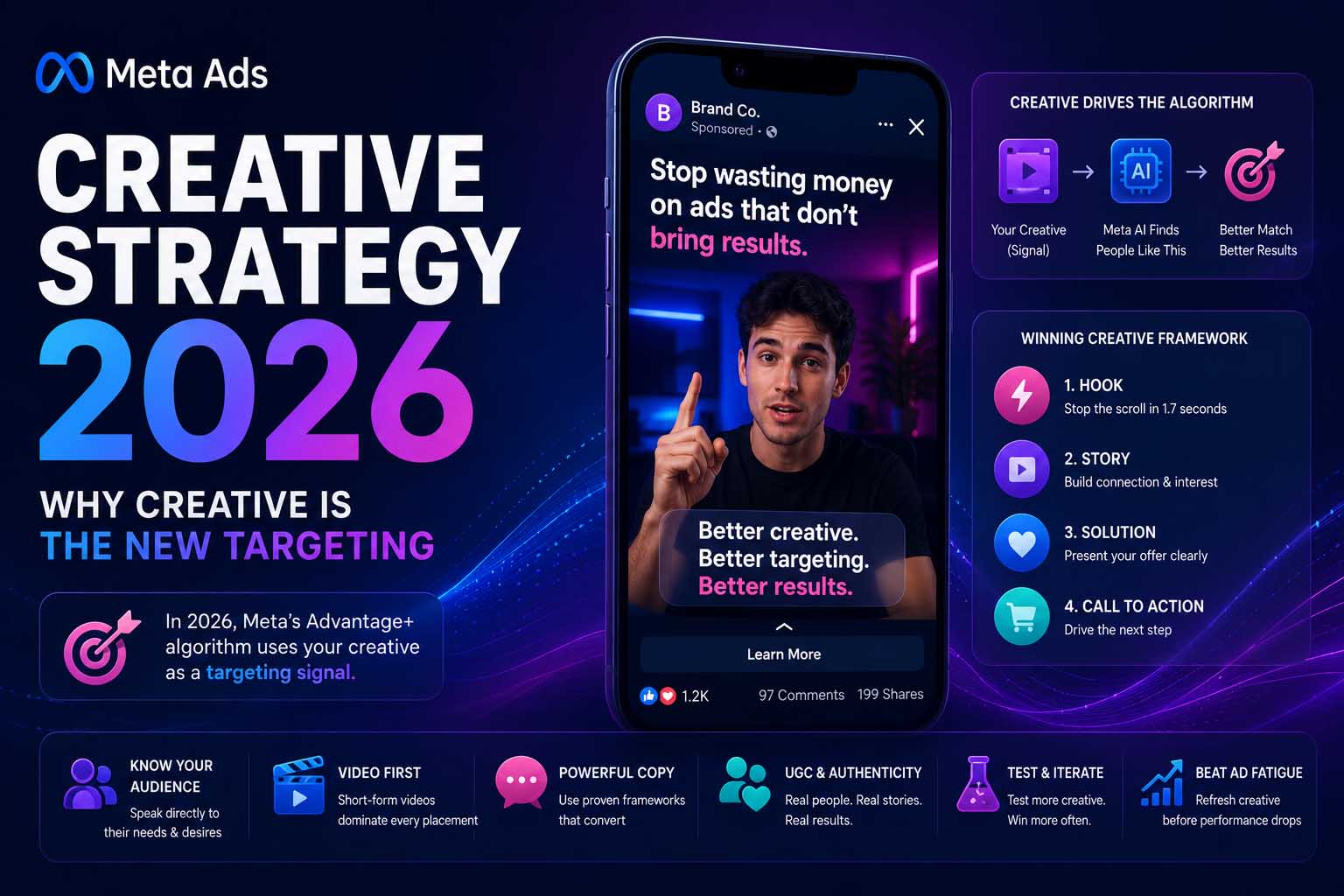
In 2022, the debate in Meta Ads was about audiences. In 2024, it shifted to bidding strategy. In 2026, the entire performance gap between winning and losing accounts comes down to one variable: creative.
Meta's Andromeda algorithm update and the widespread rollout of Advantage+ Audience effectively removed audience targeting as a competitive differentiator. When Meta's AI can find your buyers from a broad or unrestricted audience just as well as from a carefully built custom audience, the only lever left that separates you from your competitors is what you show people when it finds them.
This post covers the complete Meta Ads creative strategy for 2026 — from the hook science that stops the scroll to the testing system that finds winners at scale.
Part of the Meta Ads series: This post covers creative strategy. For campaign structure see the Meta Ads Complete Guide 2026, for targeting see Targeting Options 2026, and for retargeting setup see Facebook Ads Retargeting 2026.
The 2026 Shift: Creative IS the New Targeting
This is not a metaphor. It is a mechanical description of how Meta's algorithm now works.
When Advantage+ Audience is active, Meta uses your creative as a primary signal for finding your audience. The algorithm analyses who engages with your ad — who stops scrolling, who clicks, who watches, who converts — and finds more people with the same characteristics. Your creative is telling the algorithm who to find.
What this means practically:
- An ad that opens "E-commerce founders — this growth strategy doubled our ROAS in 30 days" will train Meta's algorithm to find e-commerce founders automatically, without any audience targeting
- A generic lifestyle image with no specific hook gives the algorithm no signal about who your ideal customer is
- Narrow interest targeting + weak creative consistently underperforms broad targeting + strong creative in 2026 tests
- Volume of creative variants matters as much as quality — more creative options give the algorithm more signals to work with
"In 2026, the main limitation for Meta ads is not targeting, but creative volume and interpretation." — Andrew Foxwell, Meta Ads strategist
The Hook: Your First 3 Seconds
Mobile users scroll through their feed at roughly 300 words per minute. You have approximately 1.7 seconds to register as relevant before they're past your ad entirely. The hook — your opening visual frame and first line of copy — is where the entire creative battle is won or lost.
The 4 Hook Mechanisms That Stop the Scroll
Pattern Interrupt
Something visually or contextually unexpected in the first frame. A blank screen before text appears. An extreme close-up. An unusual colour palette. A direct-to-camera stare. The scroll stops because the brain detected something that broke the visual pattern of the feed. Works for any product or service.
Direct Audience Call-Out
Name your specific target customer in the first frame or first spoken/written words. "Business owners in Dhaka —", "If you're running Meta Ads and losing money —", "E-commerce brands doing under $50K/month —". People are hardwired to respond to direct address. This hook simultaneously trains Meta's algorithm on who to target.
Result-First
Open with the outcome before explaining how. Show the before-after. Show the revenue screenshot. Show the transformation. "She went from 0 to 312 qualified leads in 60 days." Curiosity is created because the viewer wants to know how — and has to keep watching or reading to find out.
Problem Agitation
Open by naming a specific pain point your audience experiences. "Still paying for Meta Ads with nothing to show for it?" "Your leads aren't converting because of this one mistake." This works because the person experiencing that pain recognises themselves immediately — the ad becomes personally relevant in the first second.
Hook Testing Framework
Test hooks as the primary variable before testing anything else. Create 4–6 ads that are identical except for the opening 3 seconds. Same body copy, same offer, same CTA. Different hook mechanism for each. After 7–10 days at adequate spend, one hook will outperform the rest by a significant margin. That hook becomes your control — and tells you which mechanism your specific audience responds to most strongly.
Ad Format Strategy by Objective
| Format | Best Objective | Best Funnel Stage | Key Spec |
|---|---|---|---|
| Single Video | Any conversion objective | All stages | 9:16 for Stories/Reels, 1:1 for Feed, 15–30s for conversion |
| Single Image | Traffic, Leads, Sales | Middle and Bottom | 1080×1080px minimum, minimal text overlay |
| Carousel | Sales, Traffic | Middle and Bottom | 2–10 cards, each with unique link if needed |
| Collection | Sales (Catalogue) | Bottom — retargeting | Cover image/video + product grid beneath |
| Instant Experience | Awareness, Traffic | Top and Middle | Full-screen mobile canvas — high dwell time |
| Stories/Reels | Awareness, Engagement | Top of funnel | 9:16 vertical, max 15s for Stories, 60s for Reels |
Format Performance Insights for 2026
- Video dominates — across nearly every objective and stage, video out-performs static images in CPM efficiency and conversion rate in 2026 data
- Short beats long for cold traffic — 15–30 second videos outperform 60+ second videos for cold audiences. Longer content (2–5 minutes) can work for retargeting where brand familiarity already exists
- Reels placement is underpriced — CPM in Reels placements is typically 30–50% lower than Feed placements. If your creative is vertical-native, Reels often produces the best cost-per-result
- Carousel CTR advantage — Carousels average 20–30% higher CTR than single-image ads due to the swipe interaction driving engagement
Ad Copy Framework That Converts
Ad copy operates at three levels simultaneously: above the creative (primary text), below the creative (headline and description), and within the creative itself (video script or image text). Each level plays a different role.
Primary Text — The Story Layer
Primary text appears above your image or video. It has no character limit (though Meta truncates to ~125 characters before "See more"). Two formats consistently outperform:
Short-Form (1–3 sentences)
Gets to the point immediately. Best for retargeting audiences who already know the context. Example: "Your Meta Ads should be profitable. Most aren't because of one fixable mistake in campaign structure. See exactly what it is →"
Long-Form (5–10 sentences with line breaks)
Tells a complete story — problem, agitation, solution, proof, CTA. Best for cold traffic unfamiliar with your brand. People who read long-form copy are more qualified leads because they invested time. Format with single-sentence paragraphs and line breaks — wall-of-text copy performs poorly on mobile.
Headline — The Offer Layer
The headline appears below your creative in the link description area. It is one of the most underutilised elements in Meta Ads. Best practice: state your offer directly and specifically. Not "Learn More About Our Services" but "Free 30-Minute Meta Ads Audit — Book This Week." The headline should be the thing that makes clicking feel worthwhile.
Description — The Reinforcement Layer
Small text beneath the headline, often not shown on mobile. Use it to reinforce the headline with a secondary benefit, address a micro-objection, or add specificity. "No commitment. Results or we work for free." 15–30 characters maximum for mobile visibility.
CTA Button Selection
| CTA Button | Best For | Conversion Psychology |
|---|---|---|
| Shop Now | E-commerce products | Transactional — lowest friction for ready buyers |
| Get Quote | Service businesses, B2B | Consultative — signals customisation and personal attention |
| Learn More | Complex products, education | Low commitment — reduces anxiety in consideration stage |
| Sign Up | SaaS, newsletters, events | Action-oriented — clear expectation of account creation |
| Book Now | Appointments, consultations | Urgency implied — time-based action |
| Contact Us | High-touch services | Relationship-focused — works well with Messenger/WhatsApp |
Video Creative: The Dominant Format
Video is the dominant creative format in Meta Ads in 2026 — not because it's trendy, but because it consistently outperforms static images across most objectives and audiences when produced with the right structure.
The Winning Video Structure (30 Seconds)
The Hook
Pattern interrupt or direct audience call-out. No logo, no branding — you earn that later. Open with the single most compelling thing you can show or say about your product or problem. No slow fades or music intros.
The Problem & Agitation
Name the specific pain point your audience experiences. Make them feel understood. "Every month you're overpaying for Meta Ads that don't convert — and you probably know it." Specificity beats generality every time.
The Solution & Proof
Introduce your solution, show it working, and back it with a specific result or social proof. Not "we help businesses grow" but "our clients see an average 4.2x ROAS within 60 days." Numbers, names, and before-afters outperform generic claims.
The CTA
Single, clear, low-friction call to action. Tell them exactly what to do and what happens when they do it. "Click below, fill in 3 fields, get your free Meta Ads audit in 24 hours." Reduce perceived effort to near zero.
Essential Video Production Rules
- Add captions — 85% of Meta videos are watched without sound. Captions are not optional.
- Film in 9:16 (vertical) natively — cropped horizontal video performs significantly worse in Stories and Reels
- Put your key message in the first frame as text — if the video is muted (most are), the first frame text is your hook
- Keep motion in the first 3 seconds — static opening frames see dramatically higher scroll-past rates
- Avoid lengthy brand intros — Meta data shows ads that lead with branding have higher skip rates than problem-first openers
UGC & Social Proof Creative
User-Generated Content (UGC) — or professionally produced content designed to look like UGC — is consistently the highest-performing creative format for conversion campaigns in 2026. The reason is trust: content that looks like an organic review or recommendation converts better because it bypasses ad scepticism.
Types of Social Proof Creative
| Type | Production | Trust Level | Best Use |
|---|---|---|---|
| Authentic customer testimonial video | Real customer, unscripted | Highest | High-ticket services, health products, education |
| Screen-recorded results | Screenshot of GSC, GA, ROAS data | Very High | Marketing services, software, B2B tools |
| Before-and-after | Side-by-side comparison | High | Physical transformations, design, home improvement |
| Creator UGC (paid) | Hired creator filming in personal style | Medium-High | Consumer products needing authentic feel |
| Review screenshot ads | Designed ad with real review text | Medium | E-commerce, apps — easy to produce at scale |
Creative Testing System
Most Meta Ads accounts test too little creative and make changes too early. A disciplined creative testing system is what separates accounts that consistently find winning ads from those that plateau.
The Testing Hierarchy
- Test hooks first — 4–6 variants of opening 3 seconds, identical body
- Test formats — once winning hook identified, test video vs image vs carousel
- Test offers — free consultation vs 10% discount vs free resource vs case study
- Test copy length — short vs long form primary text
- Test CTA — "Get Quote" vs "Book Now" vs "Learn More"
Testing Rules
- Test ONE variable at a time — changing hook AND copy simultaneously makes results unreadable
- Run each test for minimum 7 days — shorter periods produce statistically unreliable results
- Use Meta's native A/B Test tool (Experiments) — prevents audience overlap between test variants
- Set a pre-defined winning metric before launching — CTR, CPL, or ROAS depending on objective
- Test at adequate spend — each variant needs minimum $30–50/day to accumulate meaningful data
- Document every test result — a testing log transforms individual experiments into compounding knowledge
Identifying & Fixing Creative Fatigue
Creative fatigue happens when the same audience has seen your ad too many times. Performance degrades not because your offer is wrong but because the creative has lost its novelty. In retargeting campaigns with small audiences, fatigue can set in within 2–3 weeks.
Fatigue Warning Signals
| Metric | Healthy Range | Fatigue Signal |
|---|---|---|
| Frequency (cold traffic) | 1.5–3.0 | Above 3.5 — creative fatigue likely |
| CTR (cold traffic) | 0.8–2.5% | Declining week-over-week with stable audience |
| CPM | Stable or declining | Rising CPM with no audience change = fatigue signal |
| Hook Rate (video) | Above 25% | Below 20% and declining |
| Cost Per Result | Stable or improving | Rising week-on-week with no targeting change |
Creative Fatigue Fix Protocol
Change the Hook Only
If the offer and body are proven, swap just the opening 3 seconds with a different hook mechanism. This is the fastest fix — same asset, new entry point. Often restores 60–80% of original performance.
Change the Format
If video is fatigued, launch the same offer as a static image or carousel. Different format presentation can re-engage an audience that has become blind to the previous format.
New Angle, Same Offer
Keep the product and CTA identical, but approach from a completely different angle. Problem-first instead of solution-first. Social proof instead of direct offer. Humour instead of authority.
The Creative Production Calendar
Waiting until creative fatigues to produce new creative means days of degraded performance between old and new. A proactive creative calendar prevents this gap.
| Cadence | Activity |
|---|---|
| Weekly | Review frequency, CTR, and hook rate on all active creatives. Flag any approaching fatigue thresholds. |
| Every 3–4 weeks | Produce and launch 2–3 new creative variants for any campaign with frequency above 2.5 |
| Monthly | Review all winning and losing creatives. Identify patterns — which hooks, formats, and messages consistently outperform |
| Quarterly | Full creative audit — retire evergreen ads that have been running 6+ months, refresh brand positioning if needed |
7 Creative Mistakes Costing You Conversions
- Generic hooks that could apply to anyone. "Introducing [Brand Name]..." or "Are you looking to grow your business?" applies to 2 billion people. It signals to no one specifically. The more specifically you address your target customer in the hook, the better it converts — and the better it targets.
- Leading with your logo or brand name. In cold traffic, no one knows or cares about your brand yet. Leading with your logo in the first frame wastes the most valuable attention window. Earn logo placement by creating value first.
- No captions on video ads. 85% of Meta videos play silently. An uncaptioned video is effectively a muted ad. Add captions to every video. This alone typically improves video ad performance by 15–20%.
- Producing too few creative variants. Running one creative per campaign and hoping it works is not a strategy — it's luck. Motion's benchmark data shows winning accounts produce 5–10x more creative variants than losing accounts and let the algorithm find the winners.
- Making changes before the learning phase completes. Pausing or changing creative during the first 50 optimisation events resets the algorithm's learning. Patience with new creative during the testing window is a performance multiplier.
- Mismatching creative to funnel stage. Introduction-style brand storytelling shown to cart abandoners, or direct product pitches shown to cold audiences who've never heard of you. Each funnel stage requires creative built for the audience's specific awareness level and objection.
- Ignoring creative fatigue until performance collapses. By the time your ROAS has halved, you've already lost weeks of efficient spend. Monitor frequency and CTR weekly. Have new creative ready before you need it.
Conclusion: Your Creative is Your Competitive Advantage
In 2026, Meta's algorithm has commoditised audience targeting. The AI finds your buyers as well or better than manual audience strategies, provided you give it enough budget and data. What the algorithm cannot do is create compelling creative for you.
Your hook, your offer, your proof, and your call to action — these are the things your competitors cannot copy overnight. A systematised approach to creative production, testing, and refresh is the single highest-leverage investment you can make in your Meta Ads account right now.
Build more creative variants. Test hooks systematically. Match creative to funnel stage. Refresh before fatigue hits. Document what works and build on it.
If you need help building a Meta Ads creative strategy that produces consistent winners — or auditing why your current creative is underperforming — book a free consultation.
Want a Meta Ads Creative Strategy Built for Your Business?
From Pixel setup and audience architecture to creative strategy and ROAS tracking — done for you.
Get a Free Meta Ads Consultation